
What's Happening?
Reservoirs in the western United States, particularly Lake Mead and Lake Powell, are facing an increasing risk of reaching 'dead pool' status. Dead pool occurs when the water level in a reservoir falls
below the dam's lowest controllable outlet, meaning water can no longer be released downstream through normal operations. This does not imply the reservoir is empty; it can still contain billions of gallons of water but becomes largely ineffective for its intended functions. For hydroelectric dams, power generation can cease even before dead pool is reached, at what is termed the 'minimum power pool,' due to insufficient hydraulic pressure. Lake Mead's estimated dead-pool elevation is 895 feet above sea level, with its minimum power pool at 950 feet. Lake Powell faces similar challenges, with its minimum power pool at 3,490 feet and dead pool near 3,370 feet. Both reservoirs have experienced significant declines over the past 25 years, with their combined storage in 2026 falling to its lowest point since before Lake Powell began filling in 1963.
Why It's Important?
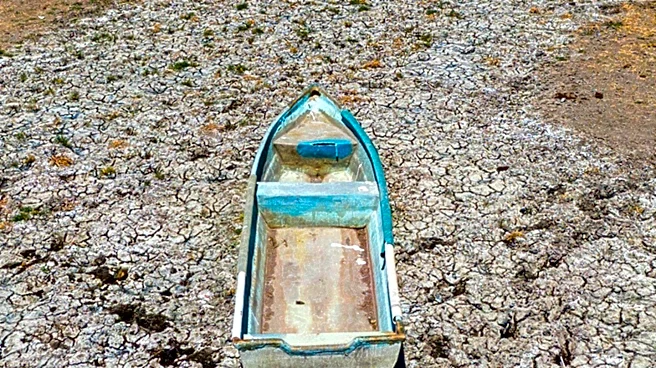
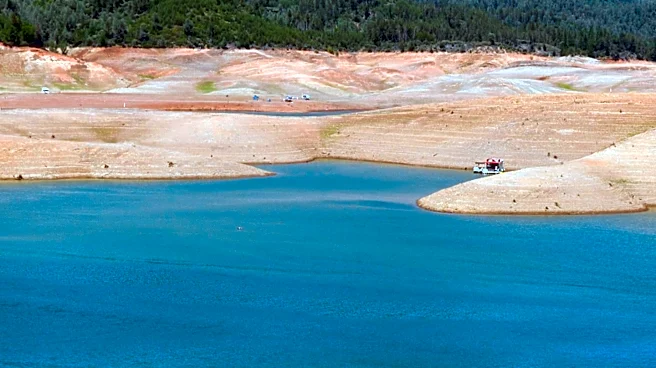
The potential for Lake Mead and Lake Powell to reach dead pool status poses severe consequences for approximately 40 million people across seven U.S. states and northern Mexico who rely on the Colorado River system. A dead pool scenario would drastically limit or completely cut off critical water supplies for cities, agriculture, and industry. This could lead to widespread water shortages, forcing farmers to leave fields unplanted or switch crops, and potentially impacting food processors, transportation, and rural economies. Furthermore, the cessation of hydropower generation would strain regional energy grids, potentially leading to increased reliance on other, possibly more expensive or less sustainable, energy sources. The ecological impact would also be significant, with reduced river flows affecting wetlands, fish habitats, water temperatures, and pollutant concentrations. The economic viability of recreation-dependent communities around these lakes would also suffer long before dead pool is reached, as receding shorelines render marinas and boat ramps unusable.
What's Next?
Avoiding dead pool for Lake Mead and Lake Powell will necessitate sustained reductions in water use, enhanced conservation efforts, and more flexible management of water releases between the two reservoirs. The seven basin states have not yet reached a consensus on long-term operational strategies. Consequently, the Department of the Interior has implemented its own decision framework for 2027 through 2036, with new operating guidelines set to take effect in October 2026. These measures aim to bring long-term water demand closer to the Colorado River's reliable supply. Localized solutions, such as Las Vegas's investment in a low-level intake and deep pumping station at Lake Mead, demonstrate efforts to secure water access even below dead pool elevations. However, broader, systemic changes in water consumption and management across the entire basin will be crucial to prevent these vital reservoirs from losing their functional capacity.
Beyond the Headlines
The looming threat of dead pool status for major U.S. reservoirs underscores a critical intersection of climate change, infrastructure resilience, and inter-state resource management. This situation highlights the long-term implications of prolonged drought and increased water demand on essential public utilities. Beyond the immediate concerns of water and power, it raises fundamental questions about sustainable growth in arid regions and the need for innovative water conservation technologies and policies. The ongoing challenges in achieving consensus among the basin states also reflect the complexities of shared resource governance, where competing interests and historical allocations must be reconciled with evolving environmental realities. This scenario could accelerate the development of new water sources, such as desalination or advanced wastewater recycling, and fundamentally alter agricultural practices and urban planning in the American West, pushing for a more adaptive and resilient approach to water security in the face of a changing climate.