








What's Happening?
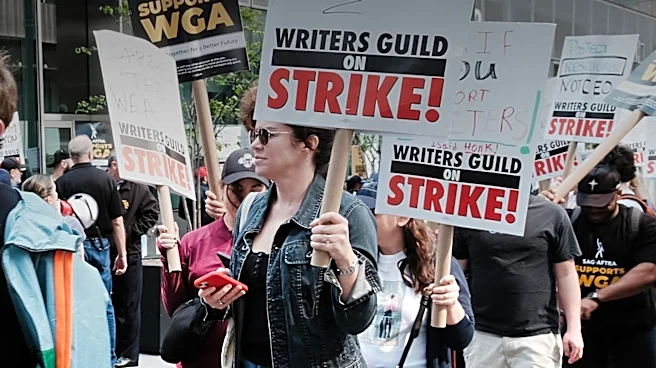
On October 27, 1969, workers at General Electric (GE), primarily organized under the International Union of Electrical Workers (IUE) and the United Electrical Workers (UE), initiated a strike. This industrial action lasted for 102 days, involving up to 164,000
workers daily. The strike aimed to counter GE's long-standing aggressive bargaining strategies and anti-union stance, ultimately leading to significant concessions from the company. This event is recognized as one of the most pivotal strikes of its era. Historically, GE's approach to labor relations, known as 'Boulwarism,' involved making a single 'take it or leave it' offer, a strategy implemented by VP Lemuel Boulware after Philip Reed took over as CEO in 1945, shifting from former CEO Gerald Swope's more conciliatory approach to unions. The 1969 strike marked a significant challenge to this established corporate strategy.
Why It's Important?
The 1969 GE strike is important because it successfully challenged 'Boulwarism,' a dominant anti-union negotiation tactic in corporate America for two decades. This strategy, where companies presented a final offer without room for compromise, had previously limited the power of unions. The strike demonstrated that organized labor, even with internal divisions (like those between IUE and UE), could unite and effectively push back against powerful corporations. The involvement of the New Left and anti-war protestors, who targeted GE due to its involvement in the Vietnam War, added a unique dimension to the labor dispute, highlighting the intersection of social and economic issues. Furthermore, the strike brought attention to issues of pay equality for women workers within GE, with women forming caucuses and connecting with feminist groups to advocate for their demands, showcasing the evolving landscape of labor activism.
What's Next?
The successful resolution of the 1969 GE strike, which cost the company $79 million in profits and saw a significant drop in fourth-quarter earnings, set a precedent for future labor negotiations. While the immediate outcome was a return to work with decent pay increases and contract adjustments, the long-term impact was the weakening of 'Boulwarism' as an effective corporate strategy. This shift encouraged more genuine negotiation and compromise in labor relations. The solidarity efforts between workers, students, and feminist groups during the strike also laid groundwork for broader social and political activism within the labor movement, potentially influencing how future labor disputes would be organized and supported. The strike's legacy suggests a continued emphasis on worker unity and the potential for external social movements to impact industrial relations.
Beyond the Headlines
The 1969 GE strike had deeper implications beyond immediate labor gains. It underscored the growing power of social movements, such as the New Left and feminism, to influence industrial disputes. The collaboration between anti-war protestors and workers, and the demands for pay equality by women workers, demonstrated a broadening scope of labor activism that integrated social justice issues with traditional economic demands. This period marked a cultural shift where corporate practices were increasingly scrutinized not just for economic fairness but also for their broader societal and ethical impacts. The strike's success in forcing GE to abandon its rigid bargaining stance also highlighted the ethical considerations of corporate power and the importance of genuine dialogue in employer-employee relations, contributing to a more nuanced understanding of corporate social responsibility.