






What's Happening?
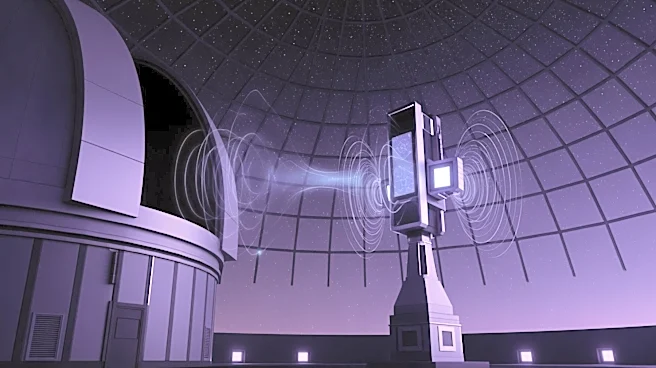
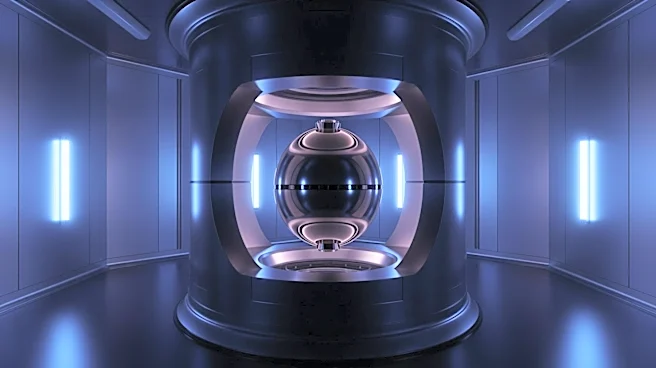
Scientists are conducting an experiment deep underground at the Sanford Underground Research Facility in South Dakota to search for dark matter. The experiment, known as LUX-ZEPLIN (LZ), involves a detector shielded from cosmic radiation by thick layers
of rock. The target is a hypothetical particle called a WIMP (Weakly Interacting Massive Particle), believed to be a candidate for dark matter, which constitutes about 85% of the universe's matter. The detector uses ultra-pure liquid xenon to capture potential interactions with WIMPs. Despite not yet detecting dark matter, the experiment helps narrow down possible theories and contributes to understanding the universe's composition.
Why It's Important?
The search for dark matter is crucial for understanding the universe's fundamental structure. Discovering dark matter would be a groundbreaking scientific achievement, providing insights into the universe's composition and the forces governing it. The experiment's ability to rule out certain theories helps refine the scientific community's understanding of dark matter. Additionally, the project offers opportunities to observe other rare phenomena, contributing to broader scientific knowledge. The collaboration involves over 250 scientists worldwide, highlighting the global effort to solve one of physics' greatest mysteries.
What's Next?
The LUX-ZEPLIN experiment will continue to collect data, aiming for nearly 1,000 days of exposure to increase its sensitivity to potential dark matter interactions. Future plans include developing a more sensitive detector, referred to as XLZD, to further explore dark matter's properties. The ongoing research will focus on eliminating false signals and refining detection methods. As the experiment progresses, it may also provide insights into other rare cosmic events, contributing to a deeper understanding of the universe.