









What's Happening?
The MetOp Second Generation-B1 weather satellite has successfully arrived at Europe’s Spaceport in French Guiana after a 10-day transatlantic voyage from Bordeaux, France. This satellite, securely housed in a transport container, was transported by the Canopée
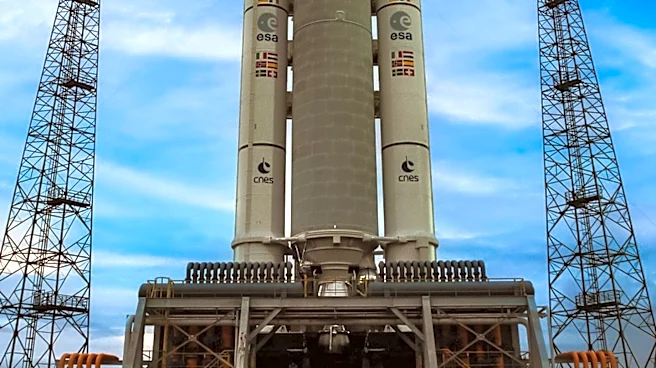
ship, an innovative vessel that combines wind power with conventional fuel for sustainable transport. Along with the satellite, 75 tonnes of essential launch-preparation equipment, spread across six additional containers, were also offloaded at Pariacabo harbour. The MetOp-SG-B1 is now set for a short storage period before being prepared for its launch aboard an Ariane 6 rocket, which is anticipated to occur at the end of the year. This marks a significant step in the satellite's journey towards its operational phase.
Why It's Important?
The arrival of the MetOp Second Generation-B1 satellite is crucial for advancing global weather forecasting and climate monitoring capabilities. As a next-generation weather satellite, it is expected to provide highly detailed and accurate data, which will enhance meteorological services across Europe and potentially worldwide. Improved weather predictions have significant economic implications, benefiting sectors such as agriculture, aviation, and maritime transport by enabling better planning and risk mitigation. Furthermore, the use of the Canopée ship, which utilizes wind power, highlights a growing commitment to sustainability in space logistics, setting a precedent for environmentally conscious practices in the aerospace industry. The successful launch of MetOp-SG-B1 on the Ariane 6 will also be a key milestone for the Ariane 6 program, demonstrating its capability to deploy critical payloads.
What's Next?
Following its arrival, the MetOp-SG-B1 satellite will undergo a period of storage before commencing final preparations for its launch. These preparations will involve rigorous testing and integration procedures to ensure the satellite is ready for its mission. The launch aboard the Ariane 6 rocket is expected by the end of the year, marking the culmination of years of development and planning. The successful deployment of MetOp-SG-B1 will pave the way for its operational phase, during which it will begin transmitting vital weather and climate data. Future steps will also involve the continuous monitoring and maintenance of the satellite in orbit, ensuring its longevity and the consistent delivery of high-quality data to meteorological organizations and scientific communities.
Beyond the Headlines
The MetOp Second Generation-B1 mission extends beyond immediate weather forecasting benefits, contributing to a deeper understanding of Earth's climate systems. The advanced instrumentation on board will collect data essential for climate change research, helping scientists track long-term environmental shifts and improve climate models. This mission underscores the increasing reliance on sophisticated satellite technology for addressing global challenges, from natural disaster preparedness to climate policy formulation. The sustainable transport method employed for the satellite's journey also reflects a broader trend towards integrating environmental responsibility into complex technological endeavors, potentially influencing future practices in space exploration and logistics. The success of this mission will reinforce Europe's leadership in space-based environmental monitoring and its commitment to international scientific collaboration.