

What's Happening?
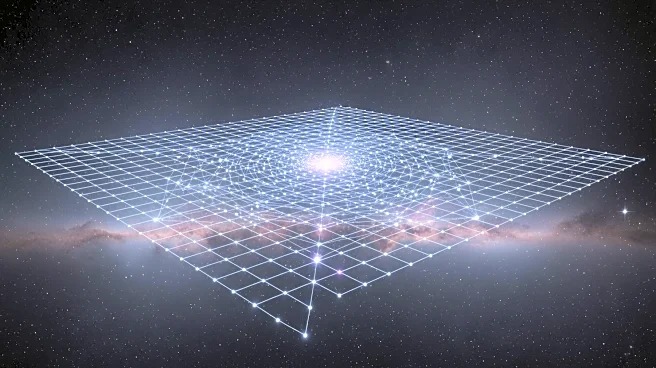
Astronomers have developed one of the most comprehensive cosmic maps to date, revealing a 'sea of light' from the early universe. This 3D map, part of the Hobby-Eberly Telescope Dark Energy Experiment (HETDEX), is based on light emitted by hydrogen, the universe's
most abundant element. The map captures the universe as it appeared 9 to 11 billion years ago, during a period of intense star formation. By using line-intensity mapping, researchers focused on the specific wavelengths emitted by excited hydrogen atoms, allowing them to chart the distribution of luminous galaxies and interstellar gas clouds. This method provides a broader view of the universe's structure, beyond just the brightest galaxies, offering insights into the distribution of mass and the influence of dark energy.
Why It's Important?
This development is significant as it enhances our understanding of the universe's structure and the forces shaping it, such as gravity and dark energy. By mapping the distribution of galaxies and interstellar matter, scientists can better understand how these elements cluster and interact. This research could lead to more accurate models of cosmic evolution and the role of dark energy in accelerating the universe's expansion. The findings have implications for cosmology, potentially refining theories about the universe's formation and development, and could influence future astronomical research and technology.
What's Next?
The next steps involve improving noise-reduction techniques to better isolate the signals from ancient galaxies amidst various interferences. Researchers aim to use fainter sources and lower-mass objects as tracers of cosmic evolution, which could provide more robust constraints on gravity models. As new instruments become available, the mapping of the cosmos is expected to enter a 'golden age,' offering even more detailed insights into the universe's past and its ongoing expansion.