








What's Happening?
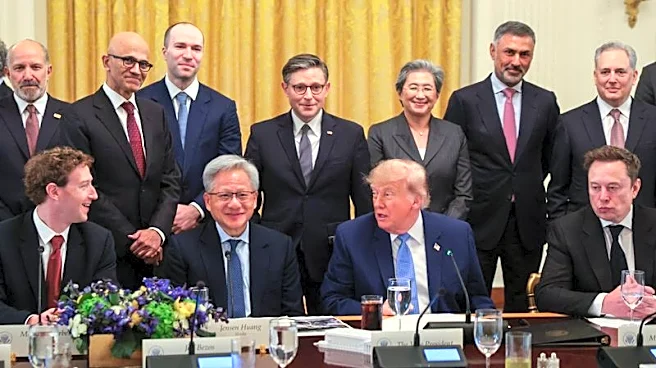
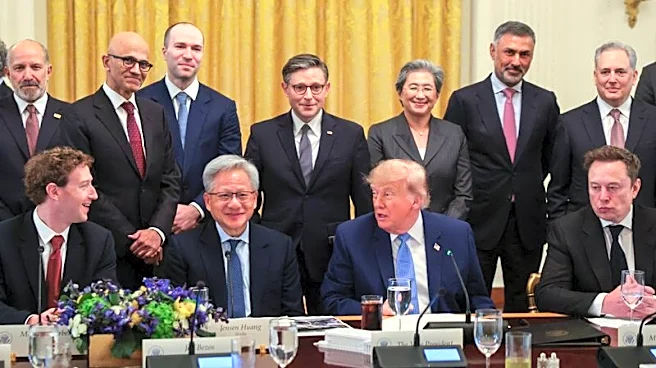
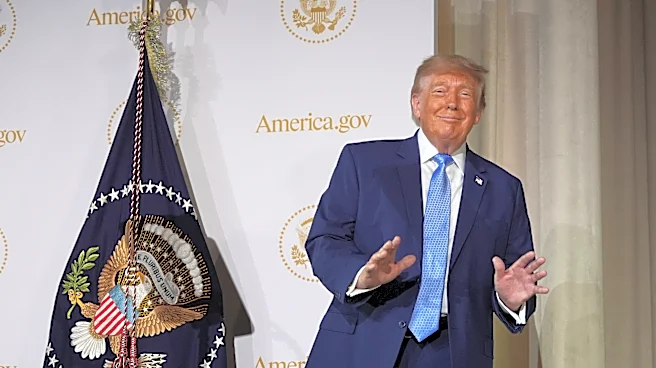
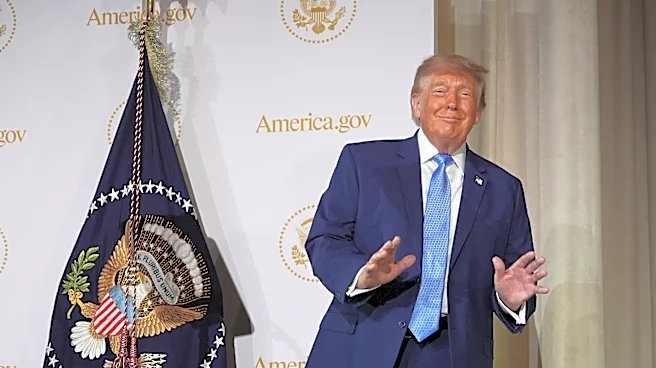
During a White House meeting focused on artificial intelligence, President Trump referred to Google and Alphabet CEO Sundar Pichai as a 'monster.' The comment was made in front of reporters and was seemingly intended as a compliment, with President Trump praising
Pichai's low public profile despite his significant influence in the technology sector. President Trump stated, 'This guy is a monster, and nobody knows him. What a great life! To be a monster and not have to go through this.' Pichai, who has led Google since 2015 and became Alphabet's CEO in 2019, responded to the remark with a light-hearted joke, saying, 'Hopefully a better tagline than I’m a monster!' The meeting also involved other prominent tech executives, including Nvidia CEO Jensen Huang and Meta CEO Mark Zuckerberg, and concluded with the signing of a voluntary 'White House Accord on Super Intelligence,' which commits companies to internal controls for AI risks and external review.
Why It's Important?
President Trump's characterization of Sundar Pichai, while seemingly jocular, highlights the immense power and influence wielded by leaders of major technology companies in the U.S. and globally. The 'monster' comment, interpreted as praise for Pichai's ability to maintain a low public profile despite his company's vast reach, underscores a broader societal perception of tech giants as powerful entities that operate with significant impact, often outside the immediate public spotlight. This interaction occurred in the context of a critical discussion about artificial intelligence, a technology with profound implications for national security, economic competitiveness, and societal structure. The voluntary 'White House Accord on Super Intelligence' signed during this meeting signifies a collaborative effort between the U.S. government and leading tech firms to address the ethical and safety concerns surrounding AI development. This accord is important as it sets a precedent for industry-led self-regulation in a rapidly evolving technological landscape, aiming to balance innovation with responsible deployment. The involvement of top tech executives in such discussions indicates the growing recognition of AI's transformative potential and the need for coordinated strategies to manage its risks and benefits.
What's Next?
Following the signing of the 'White House Accord on Super Intelligence,' the participating technology companies, including Google, are expected to implement the outlined voluntary measures. These measures include establishing robust internal controls, cooperating with independent external auditors to assess these controls, and forming board committees to review audit reports. Google, under Pichai's leadership, has already committed to investing hundreds of billions in AI and emphasizes safeguards like testing, evaluations, and 'red-teaming' before releasing models. The accord also leaves open the possibility of future governmental regulation, suggesting that if voluntary efforts prove insufficient, legislative action might follow. Stakeholders, including policymakers, civil society groups, and the public, will likely monitor the effectiveness of these self-regulatory commitments. The ongoing dialogue between the U.S. government and tech leaders will continue to shape the trajectory of AI development and its integration into society, with potential future meetings and policy discussions anticipated to refine these frameworks.
Beyond the Headlines
The interaction between President Trump and Sundar Pichai, particularly the 'monster' remark, delves into the complex relationship between political leadership and the tech industry. It subtly touches upon the perceived anonymity and immense power of tech executives, contrasting with the high-profile nature of political figures. This dynamic raises questions about accountability and transparency in an era where technological advancements, particularly in AI, are rapidly reshaping daily life. The 'White House Accord on Super Intelligence' represents a significant step towards addressing the ethical and societal implications of AI, moving beyond mere technological advancement to consider its broader impact. The emphasis on internal controls, external audits, and board oversight reflects a growing awareness of the need for responsible innovation. This collaborative approach, while voluntary, could set a precedent for how emerging technologies are governed, balancing the drive for innovation with the imperative to mitigate potential risks. The long-term implications include shaping public trust in AI, influencing global standards for AI governance, and potentially redefining the roles and responsibilities of both government and corporations in managing technological progress.