






What's Happening?
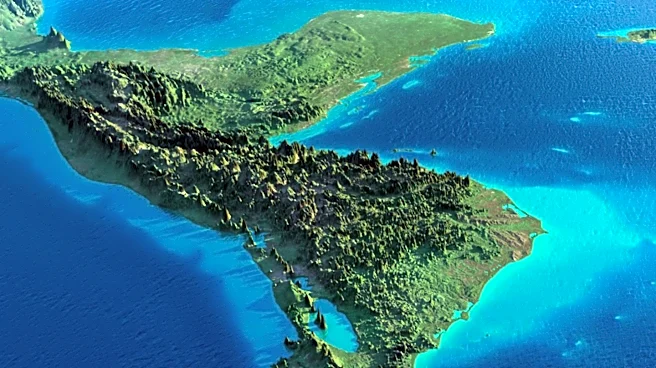
A new report titled 'Landscape of Climate Finance in Latin America and the Caribbean' by the Climate Policy Initiative indicates that while the region possesses significant climate investment opportunities and some mature markets, climate finance remains
considerably below the required levels. The report, covering the period from 2020 to 2024, highlights that climate finance flows are highly uneven across countries, sectors, and climate objectives. Brazil, Mexico, and several larger South American economies show deeper capital markets and larger project pipelines, particularly in renewable energy, industry, and land use. In contrast, smaller Caribbean, Central, and South American countries face smaller markets, high exposure to climate shocks, greater reliance on imported fuels, and more constrained fiscal space, leading to a significant disparity in climate investment.
Why It's Important?
The shortfall in climate finance for Latin America and the Caribbean has critical implications for global climate goals and regional stability. The region's distinct emissions profile, with agriculture, forestry, and other land use (AFOLU) being particularly significant in major South American countries, means that inadequate investment in climate mitigation and adaptation can exacerbate environmental degradation and climate change impacts. For the U.S., this situation poses risks related to increased climate migration, regional instability, and potential disruptions to supply chains. Investing in climate resilience and sustainable development in LAC is crucial for mitigating these risks and fostering economic growth in a key neighboring region. The uneven distribution of finance also highlights the need for targeted strategies to support vulnerable nations and ensure a just transition.
What's Next?
The report's findings are expected to prompt discussions among international financial institutions, governments, and private investors on how to bridge the climate finance gap in Latin America and the Caribbean. This may involve developing new financial instruments, increasing public and private sector collaboration, and tailoring investment strategies to the specific needs of different sub-regions and countries. There will likely be a push for greater transparency and accountability in climate finance flows. For countries with constrained fiscal space, attracting international aid and concessional financing will be paramount. The focus will also be on building project pipelines and enhancing the capacity of smaller economies to access and effectively utilize climate funds.
Beyond the Headlines
The uneven landscape of climate finance in Latin America and the Caribbean underscores deeper issues of economic inequality and vulnerability. Smaller nations, often more susceptible to climate shocks, are paradoxically less equipped to attract the necessary investments. This creates a vicious cycle where climate impacts disproportionately affect those with the fewest resources, potentially leading to increased social unrest and forced migration. The report implicitly calls for a re-evaluation of global climate finance mechanisms to ensure equitable distribution and accessibility for all vulnerable regions. It also highlights the need for innovative financial solutions that can de-risk investments in smaller markets and build local capacity for climate action, moving beyond a one-size-fits-all approach to climate funding.