



What's Happening?
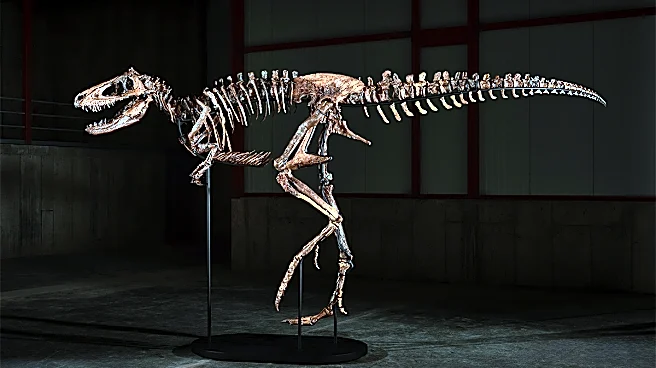
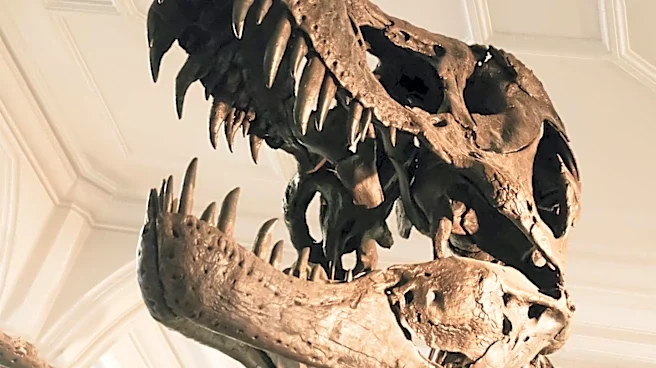
A new study published in the Journal of Paleontology presents the first evidence of a dromaeosaurid, or 'raptor,' feeding or scavenging on a tyrannosaur. Paleontology master's student Joshua Doyon's research on an 8-year-old Albertosaurus, a cousin of Tyrannosaurus
rex, found near Drumheller, Alberta, suggests that the tyrannosaur died of unknown causes and subsequently became a meal for a much smaller raptor. This finding challenges previous assumptions about the dinosaur food web, indicating a more complex ecological interaction where smaller predators could scavenge on apex predators. An alternative, less likely hypothesis, also considered, is that the bite marks were the result of cannibalism by a baby Albertosaurus on a larger subadult.
Why It's Important?
This discovery significantly alters our understanding of the Late Cretaceous food web in Alberta. It demonstrates that ecological roles were not always strictly hierarchical, with apex predators exclusively at the top. The evidence of a raptor scavenging on an Albertosaurus suggests that even large tyrannosaurs could become food sources for smaller carnivores, particularly after death. This complexity enriches our models of ancient ecosystems, highlighting the importance of scavenging and opportunistic feeding in maintaining ecological balance. It also provides valuable insights into the survival strategies of dromaeosaurids, showing their adaptability in utilizing available resources, even those from formidable predators. This finding contributes to a more nuanced view of dinosaurian trophic levels.
What's Next?
Future research will likely involve further analysis of similar fossil remains to identify more instances of inter-species scavenging or predation, particularly between different dinosaur groups. Paleontologists will continue to meticulously examine bite marks and other trace fossils to determine the identity of the trace makers and the circumstances surrounding the interactions. The study's methodology, which involved systematically eliminating possible culprits based on tooth marks, will serve as a model for future investigations. This ongoing work will help to build a more complete picture of the intricate relationships and survival dynamics within prehistoric ecosystems, potentially uncovering more unexpected ecological roles for various dinosaur species.
Beyond the Headlines
The notion of a small raptor feeding on a tyrannosaur, an animal often perceived as the ultimate predator, is a compelling narrative that challenges popular perceptions of dinosaur dominance. This finding underscores the reality that in nature, even the most powerful creatures can become part of the food chain after death, contributing to the ecosystem's nutrient cycle. It also highlights the critical role of scavengers, often overlooked, in maintaining ecological health. The study exemplifies how detailed paleontological work, even on fragmented remains, can yield profound insights into ancient behaviors and ecological structures, reminding us that the past is full of surprises and that scientific understanding is always evolving.