






What's Happening?
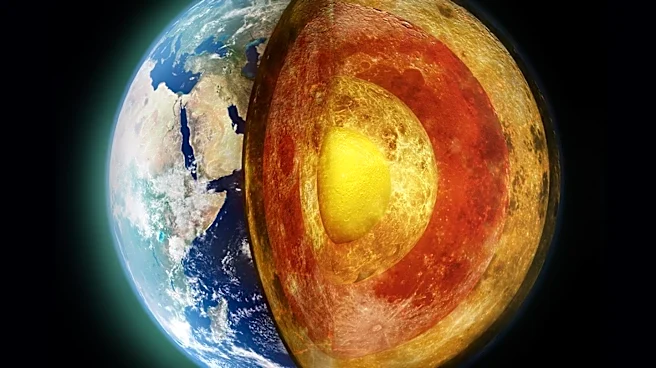
Caltech researchers, led by Nivedita Thiagarajan, have published a new study in Geology questioning the long-held interpretation of a significant carbon-isotope signal found in 2-billion-year-old rocks from the Zaonega Formation in Karelia, Russia. This
signal, along with a similar one from the Francevillian Basin in Gabon, has traditionally been seen as evidence of a worldwide environmental change during Earth's early oxygenation. The research team, including John Eiler and Aivo Lepland, analyzed gases trapped in microscopic pockets within these rocks. Their findings suggest that the unusual carbon-isotope signal at the Zaonega site can be attributed to local phenomena occurring within a several-hundred-square-kilometer sedimentary basin, rather than a global event. They propose that magma intrusions heated marine sediments, generating hydrocarbons like methane and propane. Microbes near the seafloor then consumed this methane, producing biomass with a light carbon isotope signature, which could explain the anomaly. This challenges the notion that the 'Shunga-Francevillian event' was a planet-wide disruption of the carbon cycle.
Why It's Important?
This research is important because it re-evaluates a foundational piece of evidence in understanding Earth's early history and the rise of complex life. The 'Shunga-Francevillian event' has been a cornerstone in theories about the planet's oxygenation and the subsequent evolution of organisms. By suggesting a local rather than global cause for this significant carbon-isotope anomaly, the study could necessitate a re-evaluation of models describing Earth's ancient carbon cycle and atmospheric changes. If the Russian evidence is indeed localized, it implies that the global environmental shifts during the Paleoproterozoic era might have been more complex or occurred through different mechanisms than previously understood. This could impact scientific understanding of how Earth became habitable and the timeline for the emergence of oxygen-breathing life, influencing future research directions in geochemistry, geology, and astrobiology.
What's Next?
The next step for the researchers is to investigate whether the same local explanation can account for the similar isotope signal found in Gabon. They plan to analyze samples collected through the GOE-DEEP project, co-funded by the International Continental Scientific Drilling Program. An international research team representing 18 countries will sample newly recovered cores from Gabon later this year. This comparative study aims to determine if local geological and biological processes, similar to those identified in Russia, also shaped the Gabonese rock record. The findings from this subsequent research will be crucial in either reinforcing the new local interpretation or suggesting a more complex interplay of local and global factors in Earth's ancient environmental changes. The outcome could lead to a significant shift in the scientific consensus regarding the nature and scale of the 'Shunga-Francevillian event'.
Beyond the Headlines
Beyond the immediate scientific implications, this study highlights the dynamic and often evolving nature of scientific understanding, even concerning events billions of years in the past. It underscores the importance of re-examining established theories with new data and analytical techniques. The research also demonstrates how detailed analysis of microscopic features, such as gases trapped in fluid inclusions, can provide profound insights into macro-scale planetary processes. The potential reinterpretation of a major global event as a local phenomenon could influence how scientists approach evidence from other ancient geological records, encouraging a more nuanced consideration of regional variations versus global trends. This iterative process of questioning and refining scientific models is fundamental to advancing knowledge about Earth's deep history and the conditions that fostered life.