




What's Happening?
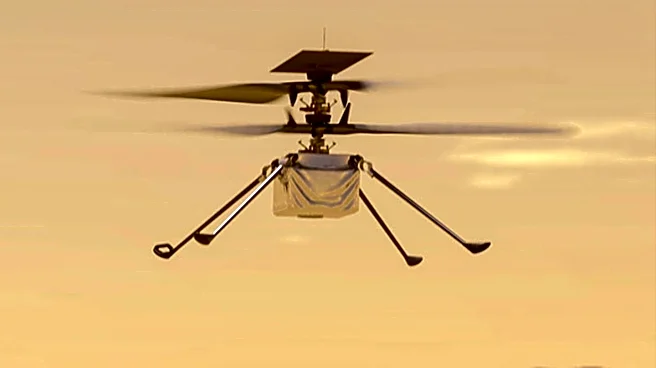
NASA's Ingenuity helicopter successfully demonstrated powered, controlled flight on Mars, a feat achieved by its unique design that allowed it to operate in an atmosphere roughly 100 times thinner than Earth's. The 1.8-kilogram helicopter utilized counter-rotating
blades that spun at approximately 2,400 revolutions per minute (rpm), nearly five times faster than a conventional passenger helicopter's main rotor, to generate sufficient lift. This high rotational speed, combined with long, lightweight carbon-fiber blades, low Martian gravity, and precise thermal control, enabled Ingenuity to complete 72 flights over nearly three years, far exceeding its initial design goal of five flights over 30 Martian days. Its first flight on April 19, 2021, marked the first powered flight on another planet.
Why It's Important?
Ingenuity's success is a monumental achievement in aerospace engineering and planetary exploration. It proved that powered flight is feasible in extremely thin atmospheres, opening new avenues for exploring other celestial bodies with similar conditions. This demonstration transforms how future planetary missions might be conceived, allowing for aerial reconnaissance, access to difficult terrains, and broader scientific data collection than rovers alone can provide. The technologies developed for Ingenuity, such as its ultralight design, high-speed rotors, and autonomous navigation systems, will inform the design of future aerial vehicles for Mars and other planets, like Saturn's moon Titan. This mission has significantly expanded humanity's capabilities for extraterrestrial exploration and scientific discovery.
What's Next?
While Ingenuity's flying mission concluded after Flight 72 due to rotor blade damage, its legacy will profoundly influence future space missions. NASA and other space agencies are now exploring the development of more advanced Martian helicopters and other aerial vehicles, potentially larger and equipped with scientific instruments. These future aircraft could serve as scouts for rovers, explore canyons and cliffs, or even carry small payloads. The data and lessons learned from Ingenuity's extended mission will be critical in designing these next-generation explorers, focusing on improved navigation in challenging terrains, enhanced durability, and greater scientific capabilities. The success of Ingenuity has firmly established aerial mobility as a vital component of future planetary exploration strategies.
Beyond the Headlines
Ingenuity's mission transcends its technological achievements, symbolizing humanity's persistent drive to push the boundaries of what's possible. The helicopter's ability to overcome the extreme challenges of Martian flight—from the thin atmosphere and harsh temperatures to the communication delays requiring full autonomy—showcases the ingenuity and dedication of the scientific and engineering communities. This mission also highlights the importance of technology demonstrations in space exploration, where a small, focused project can yield groundbreaking results that reshape future endeavors. Furthermore, the use of commercial mobile-device components in Ingenuity's design points to a trend of leveraging readily available technology to reduce costs and accelerate development in space missions, making ambitious projects more attainable. Ingenuity has not only opened the Martian skies but also inspired a new generation of space explorers and innovators.