



What's Happening?
Astronomers Emma Jane Weller and Priyamvada Natarajan from Yale University, along with Colin Burke from the University of North Texas, have published a new study in The Astrophysical Journal Letters suggesting that 'wandering black holes' can provide
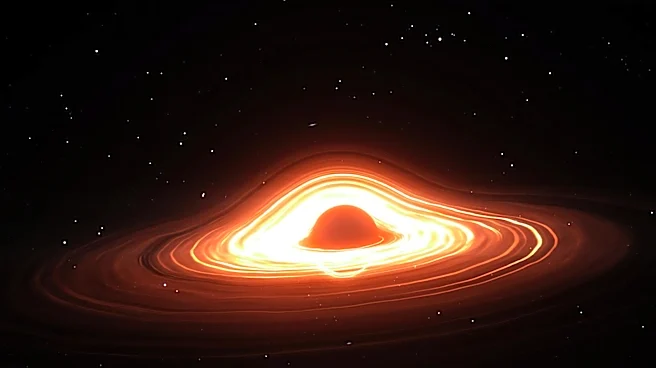
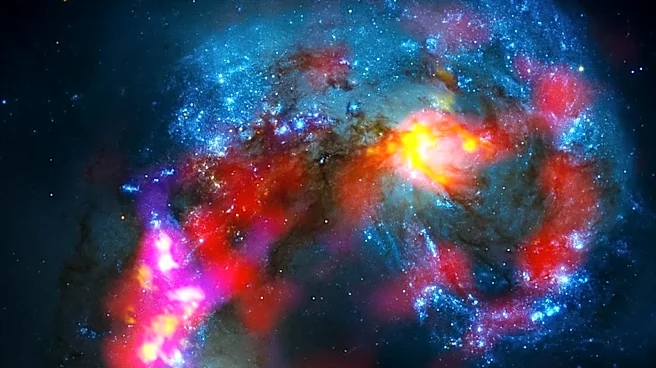
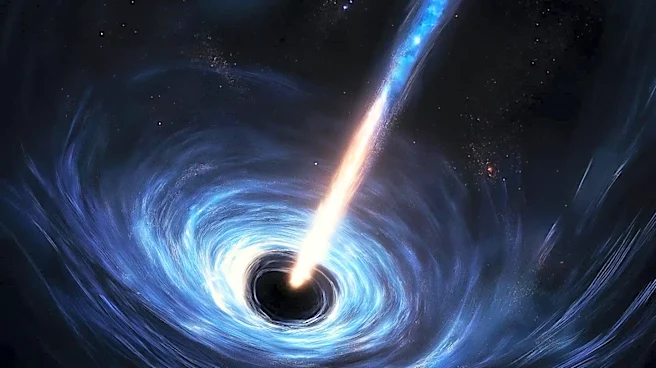
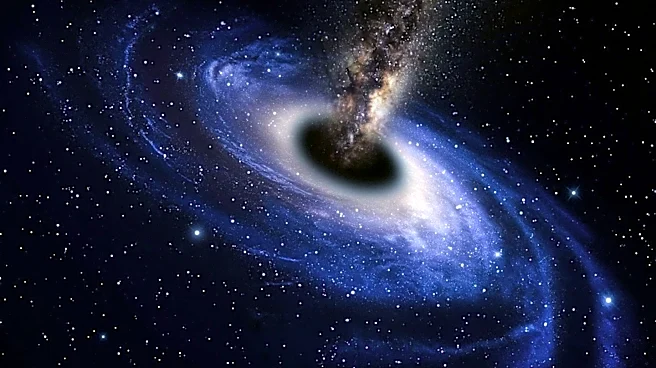
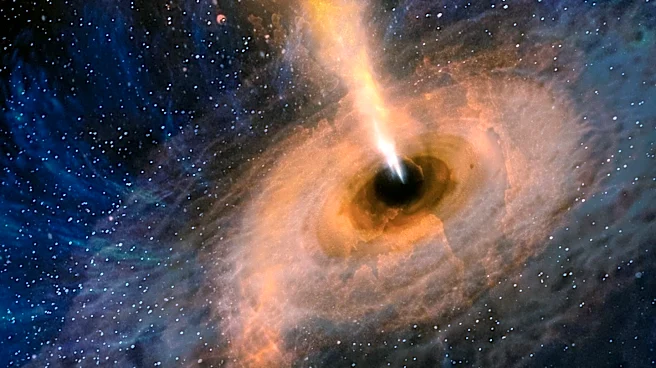
crucial information about the origins and evolution of galaxies. Traditionally, black holes are thought to reside at the centers of galaxies. However, this research indicates that galactic mergers can displace black holes, causing them to wander far from their original positions for billions of years. This phenomenon is particularly pronounced in smaller galaxies, where weaker gravitational fields make it harder for displaced black holes to return to the center. The team utilized the ASTRID cosmological simulation, which tracks the evolution of dark matter, gas, stars, and black holes over 12.6 billion years, to distinguish between centered and wandering black holes. The simulation revealed that low-mass galaxies are more likely to host wandering black holes, while those that have ceased star formation tend to have centered black holes.
Why It's Important?
This study challenges the conventional understanding of black hole locations and their role in galaxy formation. By demonstrating that black holes can 'wander,' it opens a new avenue for understanding the early universe and the mechanisms by which the first black holes, or 'seeds,' formed. The locations and abundance of these wandering black holes in smaller galaxies could preserve vital clues about these initial conditions, even after billions of years of cosmic evolution. This is significant because scientists are still debating the 'light' versus 'heavy' seed theories for black hole formation. The research also suggests a link between the presence of wandering black holes and a galaxy's star-forming activity, indicating that the dynamics of black holes are intimately connected to the overall life cycle of their host galaxies. This provides a more comprehensive framework for studying black hole origins and galaxy evolution.
What's Next?
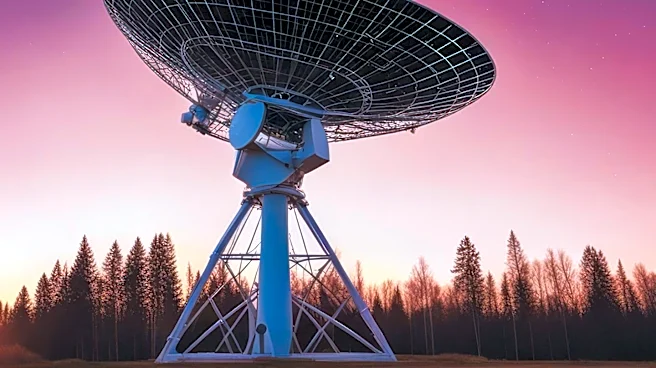
The findings from this simulation-based study necessitate observational verification. Astronomers will now focus on developing and employing methods to detect these elusive wandering black holes in real galaxies. Since wandering black holes do not emit light themselves, detection will rely on indirect evidence, such as the radiation produced by nearby gas falling towards them or brief flares caused by stars being torn apart. The researchers propose a multi-faceted approach involving deep x-ray observations, optical and infrared spectroscopy, and radio measurements. Combining these observational techniques with the insights gained from simulations will be crucial for identifying the imprints of black hole formation and galaxy evolution. This will help confirm whether real galaxies exhibit the patterns observed in the ASTRID simulation and further refine our understanding of cosmic history.
Beyond the Headlines
The concept of 'wandering black holes' adds a dynamic and complex layer to our understanding of the universe. It suggests that galaxies are not static systems with fixed central black holes, but rather evolving environments where gravitational interactions can lead to significant displacements over cosmic timescales. This fluidity implies that the history of a galaxy is not solely recorded in its central black hole but also in the trajectories and current locations of its displaced black holes. This perspective could lead to a re-evaluation of how we interpret observational data and how we model galactic evolution. Furthermore, the idea that black holes act as 'cosmic archivists' highlights their potential to unlock secrets about the universe's earliest moments, connecting the present-day distribution of these objects to the fundamental processes that shaped the cosmos.