




What's Happening?
A group of scientists in Europe, including Francesco Sannino of the University of Naples Federico II and the Quantum Field Theory Center at the University of Southern Denmark, along with Giacomo Cacciapaglia, Manuel Del Piano, and Vania Vellucci, have
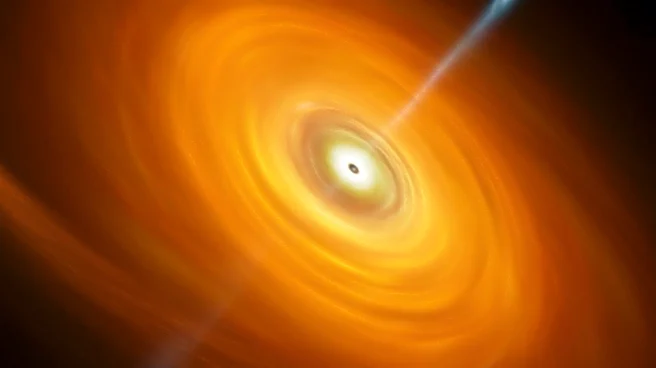
conducted calculations suggesting that a black hole could theoretically split into two under specific conditions. This research challenges the conventional understanding that black holes, due to their immense gravitational pull, are nearly impossible to break apart. The study outlines the precise circumstances required for such an event, noting that the resulting two black holes would need to separate rather than immediately recombine. The team describes the event horizon of a splitting black hole as forming a 'pair-of-pants topology.' While no such event has ever been observed, the theoretical framework explores the mechanics of black hole fragmentation, particularly focusing on the role of rapid rotation.
Why It's Important?
This theoretical research is significant because it pushes the boundaries of our understanding of black hole physics and the fundamental laws of the universe. If proven possible, the fragmentation of black holes could introduce new avenues for studying extreme gravitational phenomena and the nature of spacetime. It challenges the long-held assumption of black hole indestructibility and could lead to a re-evaluation of how black holes evolve and interact. The study also touches upon the concept of entropy in black holes, suggesting that while a split would typically reduce entropy and be thermodynamically unlikely for non-rotating black holes, rapid rotation could alter this dynamic. This could have implications for theoretical cosmology and our models of the early universe, especially concerning primordial black holes.
What's Next?
The next steps for this research involve further quantifying the probability of a black hole splitting, which depends on how gravity behaves beyond Einstein’s theory. The scientists anticipate that smaller primordial black holes might be more susceptible to splitting than larger astrophysical black holes. Future efforts may focus on indirect detection methods; for instance, gamma-ray telescopes like Fermi-LAT could search for signals from tiny black-hole fragments that might form during mergers. This would involve developing specific observational signatures that could distinguish a black hole split from other cosmic events. The team also plans to explore the implications of their findings for various gravitational theories and to refine the conditions under which such a fragmentation could occur, potentially leading to new predictions for observable phenomena.
Beyond the Headlines
The concept of a black hole splitting delves into profound theoretical physics, touching upon the interplay between general relativity, quantum mechanics, and thermodynamics. The 'pair-of-pants topology' described for the event horizon during a split offers a fascinating geometric interpretation of such an extreme event. This research highlights the ongoing quest to understand the most enigmatic objects in the universe and the limits of physical laws. It also underscores the iterative nature of scientific discovery, where theoretical calculations can open up entirely new possibilities that were previously considered impossible. The potential for black holes to fragment could also influence theories about the information paradox and the ultimate fate of matter that falls into black holes, prompting deeper philosophical and scientific inquiries into the fabric of reality itself.