




What's Happening?
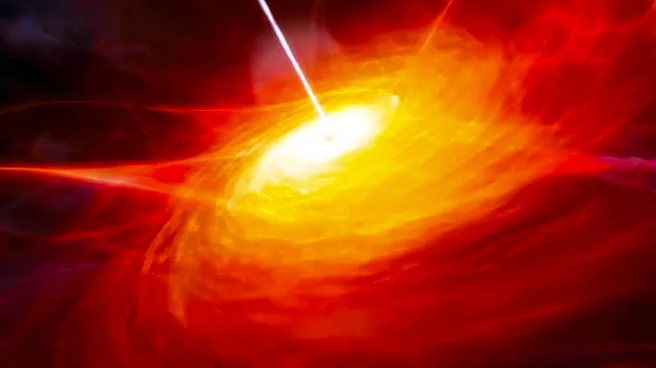
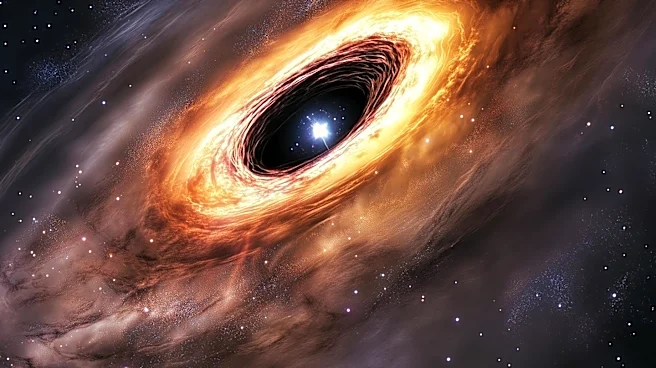
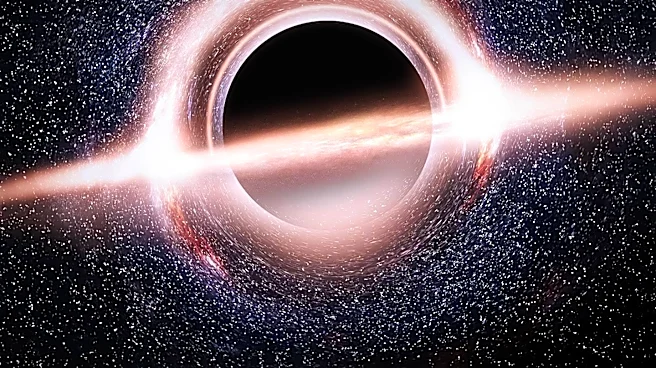
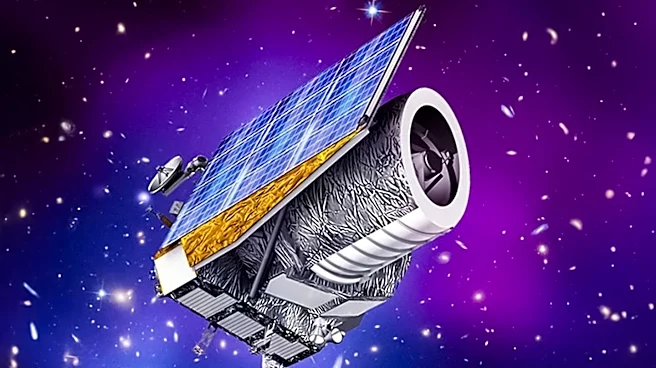
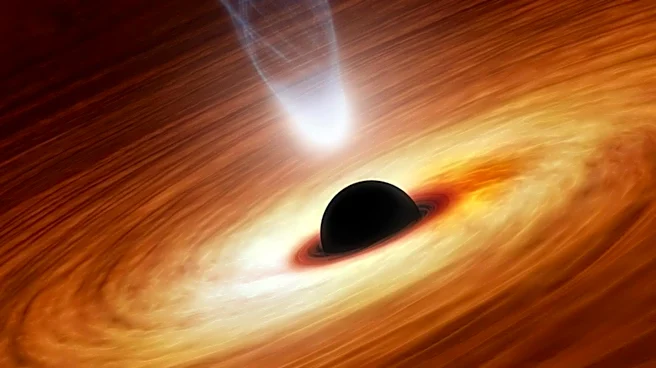
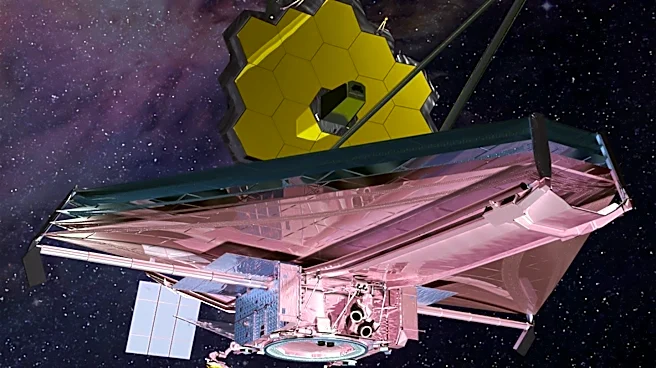
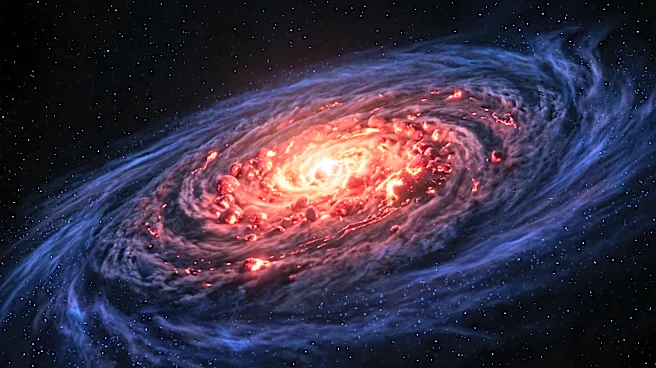
The mysterious 'little red dots' observed by the James Webb Space Telescope (JWST) in the early universe may be rapidly growing black holes encased in dense gas envelopes. This conclusion stems from a computer simulation of the early universe, which unexpectedly
produced these objects without specific parameter adjustments. The simulation, led by Sunmyon Chon of the Max Planck Institute for Astrophysics, suggests that these black holes began their growth with much larger initial masses, forming from supermassive stars of several hundred thousand solar masses. These stars, prevented from fragmenting by ultraviolet radiation from neighboring star-forming galaxies, collapsed into black holes of approximately one million solar masses. By 650 million years after the Big Bang, these objects had already reached about 30 million solar masses, significantly larger than the Milky Way's central black hole, Sagittarius A*.
Why It's Important?
This potential explanation for the 'little red dots' addresses two significant puzzles in astronomy: the rapid growth of supermassive black holes in the early universe and the nature of these compact, red-shifted sources. Traditional models struggle to explain how black holes could have grown to billions of solar masses so quickly. The 'quasi-star' configuration, where a black hole is enveloped in a giant cocoon of gas, allows for mass accretion at rates far exceeding the Eddington limit, which is typically constrained by the black hole's own radiation. This mechanism provides a plausible pathway for the early and rapid formation of supermassive black holes, fundamentally altering our understanding of galactic evolution and the cosmic timeline of black hole development. It also offers a concrete interpretation for the spectral characteristics of the 'little red dots,' linking their color and broad hydrogen lines to radiation passing through and being altered by the dense gas envelope.
What's Next?
The research team plans to further test this scenario by running simulations under different initial conditions to confirm its reproducibility. They will also develop new predictions to compare with ongoing and future data from the James Webb Space Telescope, as observations of 'little red dots' continue to accumulate rapidly. While the current simulation covers only a specific region of the early universe and does not include phenomena like plasma jets or winds, which can eject matter, future iterations may incorporate these elements to provide a more complete picture. The goal is to refine the model and gain a deeper understanding of how these early black holes influenced the evolution of galaxies and the universe as a whole.
Beyond the Headlines
This discovery challenges long-held assumptions about the initial conditions and growth rates of black holes, suggesting a more dynamic and accelerated evolutionary path than previously thought. The concept of a 'quasi-star' — a black hole within a massive gas cocoon — introduces a novel mechanism for rapid mass accumulation, pushing the boundaries of theoretical astrophysics. This research highlights the power of advanced simulations in conjunction with observational data from cutting-edge instruments like the JWST to unravel cosmic mysteries. It underscores the continuous evolution of scientific understanding, where new data can necessitate significant revisions to established theories, ultimately leading to a more accurate and comprehensive model of the universe.