





What's Happening?
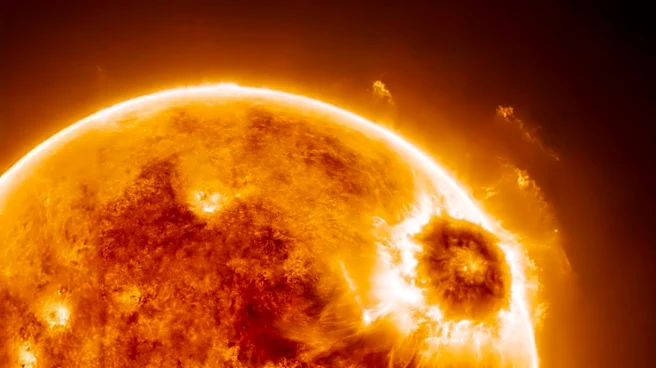
Scientists have successfully captured the most detailed images of the sun's surface to date, using the National Science Foundation's Daniel K. Inouye Solar Telescope located in Maui, Hawaii. The images reveal intricate feathery patterns and ripples of instability
on the sun's surface, caused by magnetized plasma moving at varying speeds. This phenomenon, akin to waves stirred by wind over water, has been observed on Earth and other planets but never at this level on the solar surface. The research, initially aimed at testing the telescope's capabilities, has provided new insights into the sun's outer shell, which could help in understanding solar dynamics better.
Why It's Important?
The detailed images of the sun's surface are crucial for advancing our understanding of solar phenomena, particularly coronal mass ejections (CMEs). These massive bursts of energy can impact Earth by triggering solar storms, which have the potential to disrupt GPS communications and create auroras. By studying the sun's surface in such detail, scientists can improve predictions of solar activity and mitigate the effects of solar storms on technology and communication systems. This research represents a significant step forward in solar physics, offering potential benefits for industries reliant on satellite and communication technologies.
What's Next?
Future research will likely focus on further analyzing the data obtained from these images to enhance predictive models of solar activity. Scientists may also explore the implications of these findings for understanding other solar phenomena and their potential impacts on Earth. Continued observations using advanced telescopes could lead to more discoveries about the sun's behavior, contributing to the development of strategies to protect technological infrastructure from solar-induced disruptions.
Beyond the Headlines
The ability to observe the sun's surface in such detail opens new avenues for research into the fundamental processes governing solar dynamics. This could lead to a deeper understanding of the sun's influence on the solar system and its role in space weather. The findings also highlight the importance of investing in advanced scientific instruments and international collaboration in space research.