


What's Happening?
Vladimir Airapetian, a senior astrophysicist at NASA Goddard Space Flight Center, and his colleagues are challenging conventional theories regarding the origin of life on Earth. They are addressing two primary conundrums: how simple molecules evolved
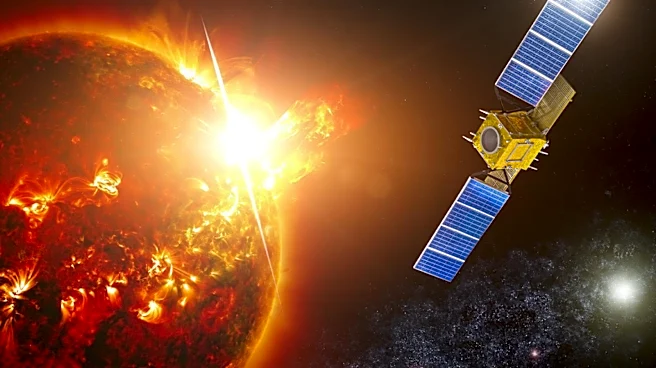
into complex ones, and how early Earth sustained liquid water despite a fainter young Sun. Airapetian suggests that solar flares from the young Sun could have provided the energy needed to break apart atmospheric nitrogen, leading to the formation of complex organic molecules. Furthermore, their models propose that a specific concentration of nitrous oxide in the early Earth's atmosphere could have warmed an equatorial band to 2-3 degrees Celsius, allowing for a 'cold start' to life. This scenario would have prevented the evaporation of organic molecules like hydrogen cyanide from small lakes while promoting further chemical complexity. The research emphasizes the importance of alkaline conditions for life, contrasting with the acidic conditions that would result from excessive carbon dioxide, which is a problem for other theories.
Why It's Important?
This research is important because it offers a new perspective on the conditions necessary for the genesis of life, potentially reshaping astrobiological search strategies. By proposing a 'cold start' scenario, Airapetian's work challenges the long-held assumption that a warm, carbon dioxide-rich environment was essential for early life. This shift in understanding could influence how scientists interpret data from exoplanets and where they focus their search for biosignatures. The emphasis on alkaline conditions and the role of boron in stabilizing ribose highlights specific chemical prerequisites for life, providing more targeted criteria for identifying potentially habitable worlds. If proven, this theory could significantly advance our comprehension of abiogenesis and the prevalence of life beyond Earth, impacting the broader scientific community and public understanding of our place in the universe.
What's Next?
Over the next two decades, astrobiologists, including Airapetian, plan to utilize new ground and space telescopes to search for biosignatures on rocky planets orbiting solar-type stars. Airapetian specifically advocates for looking for spectroscopic traces of nitrous oxide in the atmospheres of these exoplanets. The presence of nitrous oxide would indicate a nitrogen-rich and carbon dioxide-rich atmosphere, which he considers a basic prerequisite for prebiotic chemistry. While acknowledging that the exact pathway of life's origin may remain an 'unsolvable puzzle,' this targeted approach aims to identify environments conducive to the initial stages of life. This focus on specific atmospheric compositions could refine the search for extraterrestrial life and provide empirical data to support or refute the 'cold start' hypothesis.
Beyond the Headlines
The 'cold start' theory for life on Earth has profound implications beyond the immediate scientific community, touching upon philosophical and ethical considerations regarding the uniqueness of life. If life can emerge under a wider range of conditions, particularly colder ones, it increases the statistical probability of life existing elsewhere in the cosmos. This could fuel public interest in space exploration and astrobiology, potentially influencing funding for related scientific endeavors. The debate also highlights the dynamic and evolving nature of scientific understanding, where long-standing paradigms can be challenged by new models and data. Furthermore, the focus on specific chemical conditions like alkalinity and the role of boron underscores the intricate and delicate balance required for life to emerge, prompting deeper reflection on the fundamental building blocks of biological systems.