



What's Happening?
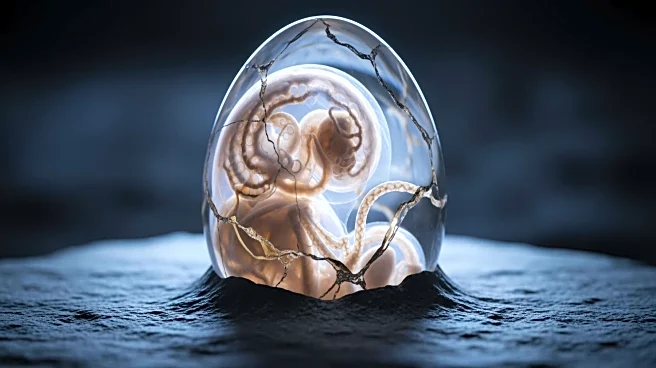
Researchers have successfully scanned 200-million-year-old dinosaur embryos using a particle accelerator, revealing unprecedented details about their development. The embryos, belonging to the species Massospondylus carinatus, were discovered in South
Africa in 1976. By utilizing the European Synchrotron Radiation Facility's powerful X-ray beams, scientists created detailed 3D models of the embryos' skulls, uncovering two distinct types of teeth. This discovery provides new insights into dinosaur development, showing similarities with modern reptiles. The study, published in Palaeontology, highlights the potential of advanced imaging technology in paleontological research.
Why It's Important?
This breakthrough in paleontological research offers a deeper understanding of dinosaur development and evolution. The ability to study such ancient embryos in detail can shed light on the evolutionary processes that shaped early dinosaurs, providing valuable information about their growth patterns. The findings also demonstrate the effectiveness of advanced imaging technologies in uncovering details that were previously inaccessible, paving the way for future studies on other fossilized embryos. This research not only enhances scientific knowledge but also underscores the importance of technological advancements in the field of paleontology.