







What's Happening?
A recent study published in Nature Communications reveals that while trees can mitigate nearly half of the urban heating caused by pavement and buildings globally, they are less effective in hotter, poorer cities where cooling is most needed. The study found
that tree cover cools cities by an average of 0.27 degrees Fahrenheit, but without trees, urban areas would warm by 0.56 degrees Fahrenheit due to the urban heat island effect. This effect is distinct from climate change caused by fossil fuel emissions. The research analyzed temperatures across nearly 9,000 large cities, highlighting that wealthier cities benefit more from tree cover, while poorer cities, particularly in hot, dry regions, receive minimal cooling benefits.
Why It's Important?
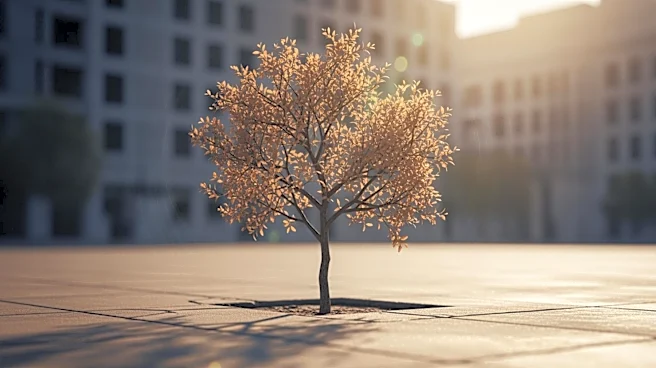
The findings underscore a significant inequality in urban cooling benefits provided by trees, with wealthier cities enjoying more relief from heat. This disparity is critical as urban heat can have severe health impacts, including heat-related illnesses and deaths. The study suggests that increasing tree cover in poorer, hotter cities could provide much-needed relief, but challenges such as water scarcity and land availability limit this potential. The research emphasizes the need for targeted urban planning and policy interventions to address these disparities and improve living conditions in vulnerable urban areas.
What's Next?
The study advocates for increased efforts to plant trees in cities that need them most, despite the challenges. However, it also acknowledges that trees alone cannot solve the broader issue of climate change. Urban planners and policymakers are encouraged to integrate tree planting with other climate adaptation strategies to maximize benefits. Future urban development plans may need to prioritize equitable distribution of green spaces to ensure all communities can benefit from the cooling effects of trees.