
What's Happening?
The United States has announced new sanctions targeting Venezuela, specifically focusing on three nephews of President Nicolas Maduro's wife and six crude oil tankers and shipping companies associated
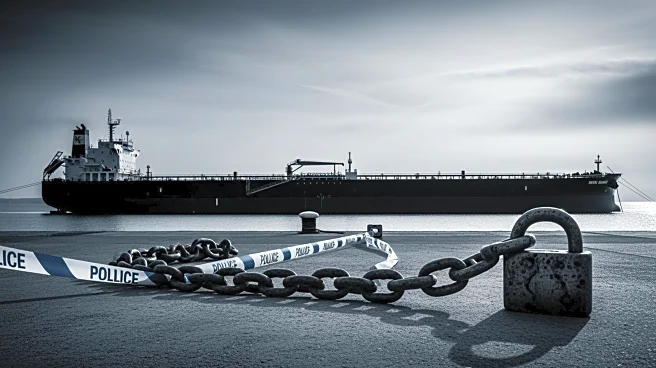
with them. This move is part of a broader strategy by the U.S. to increase pressure on the Venezuelan government. The U.S. Treasury Department stated that these tankers have been involved in deceptive and unsafe shipping practices, contributing financial resources to what it describes as Maduro's corrupt regime. The tankers, flagged by Panama, the Cook Islands, and Hong Kong, have been identified as supertankers that recently loaded crude oil in Venezuela. The sanctions also extend to Franqui Flores and Efrain Antonio Campo Flores, known as the 'narco nephews,' who were previously convicted in the U.S. for attempting a cocaine deal but were released in a 2022 prison swap.
Why It's Important?
These sanctions are significant as they represent a continued effort by the U.S. to isolate the Venezuelan government economically and politically. By targeting the shipping companies and tankers, the U.S. aims to disrupt Venezuela's oil exports, a critical source of revenue for the Maduro administration. This action could lead to increased economic pressure on Venezuela, potentially forcing the government to make concessions or face further isolation. The sanctions also serve as a warning to other shipping companies that might consider engaging in similar activities, thereby tightening the economic noose around Venezuela. The move has already caused oil prices to rise and has escalated tensions between Washington and Caracas.
What's Next?
The U.S. administration is reportedly planning additional tanker seizures, which could further strain relations with Venezuela. The sanctions may lead to a reduction in Venezuela's oil export volumes as shipping companies become wary of the risks involved. This could force Venezuela to offer wider price discounts or more flexible terms to retain customers. The U.S. has also indicated a willingness to continue military actions in the region, which could lead to further geopolitical tensions. The international community will be watching closely to see how these developments unfold and whether they will lead to any significant changes in Venezuela's political landscape.
Beyond the Headlines
The sanctions highlight the complex interplay between international law, economic sanctions, and geopolitical strategy. They raise questions about the effectiveness of sanctions as a tool for political change and the ethical implications of using economic pressure to achieve foreign policy goals. The situation also underscores the challenges faced by countries like Venezuela that are heavily reliant on a single export commodity. The long-term impact of these sanctions could lead to shifts in global oil markets and influence the strategies of other nations dealing with similar issues.