






What's Happening?
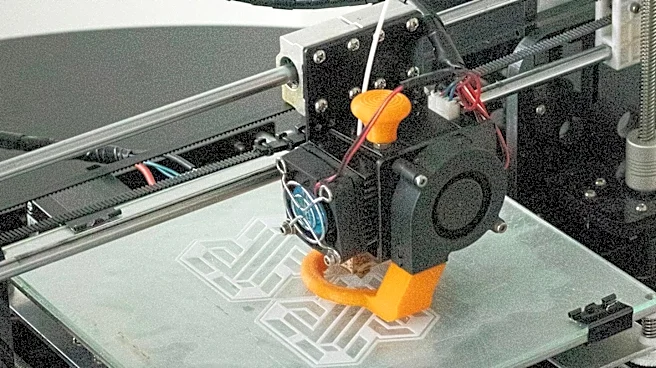
Scientists and engineers at Lawrence Livermore National Laboratory (LLNL) have created a camera-based inspection system that utilizes artificial intelligence (AI) and machine learning (ML) to monitor complex 3D-printed structures layer by layer. This
system is designed to detect tiny variations and potential problems in real-time, before a part is even removed from the printer. The technology, detailed in the Nature publication npj Advanced Manufacturing, integrates cameras mounted on 3D printers with ML-based image segmentation and computer vision tools. This allows for the conversion of thousands of images captured during the printing process into detailed measurements and spatial maps of the deposited material. The project's technical lead, Brian Weston, highlighted that this system provides a 'brain behind the eyes,' enabling data-informed decisions during printing. The automated pipeline can analyze images approximately 100,000 times faster than a human, significantly reducing the time and labor traditionally required for inspecting components produced through direct ink writing and other advanced manufacturing techniques.
Why It's Important?
This innovation holds significant importance for U.S. manufacturing, particularly in advanced sectors. By enabling early detection of defects, the LLNL system can drastically reduce the costs and time associated with producing complex 3D-printed parts. Traditionally, inspections are expensive, time-consuming, and often occur after manufacturing is complete, leading to wasted materials and resources if defects are found. This new system acts as a 'first-pass check,' allowing for parts with significant flaws to be scrapped earlier, saving valuable resources. The technology is adaptable to various additive manufacturing (AM) techniques, conventional subtractive manufacturing, and experimental systems, suggesting broad applicability across different industries. Principal investigator Brian Giera emphasized that on-machine inspection is a 'huge unlock' for decreasing costs and increasing throughput, providing more information on manufactured items. This capability is crucial for industries relying on high-precision components, such as aerospace, defense, and medical devices, where the integrity of each part is paramount.
What's Next?
The immediate goal for this technology is to identify defective parts earlier in the manufacturing process. The capability is slated for transfer to the Kansas City National Security Complex for evaluation on production-relevant systems and components, indicating a move towards practical application in national security manufacturing. Longer term, researchers envision a more autonomous system where the inspection data can feed simulations and digital twins. This integration would link a part's measured structure to its predicted performance, potentially accelerating part acceptance and qualification beyond mere defect detection. Brian Weston anticipates a future where the printer can inspect its own work and make 'accept/reject calls,' assessing whether a detected defect renders a part nonconforming. This progression points towards a future of highly automated and self-correcting manufacturing processes, enhancing efficiency and reliability across various U.S. industrial sectors.
Beyond the Headlines
The development of this AI-powered inspection system represents a foundational step towards greater manufacturing autonomy, a critical element for the future of U.S. industrial competitiveness. As Brian Giera noted, an autonomous system 'could not function properly without reliable measurement and inspection techniques.' This technology addresses not only the practical aspects of quality control but also the broader shift towards 'Industry 4.0' principles, where smart factories and interconnected systems are paramount. The ability to inspect parts whose dimensions exceed practical X-ray computed tomography (CT) coverage also opens doors for manufacturing larger, more intricate components with assured quality. Ethically, this system promotes resource efficiency by reducing waste and potentially lowering the environmental footprint of manufacturing. Culturally, it signifies a growing reliance on AI and machine learning to augment human capabilities in complex industrial processes, pushing the boundaries of what is achievable in advanced manufacturing and potentially reshaping the workforce requirements in these sectors.