





What's Happening?
Two senior students from the University of Hawaii at Hilo, Leilani Jensen and Raven Kromer, have won a $50,000 national NASA award for their innovative design to feed astronauts on Mars. Their project, named 'ʻŌhā Kanu,' was one of five winners selected
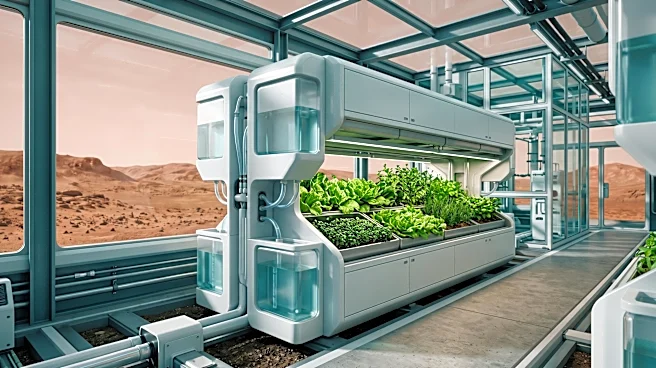
from over 100 entries in NASA’s Deep Space Food Challenge: Mars to Table. The design adapts the ancient Hawaiian ahupuaʻa land management system, integrating hydroponics, aquaculture, field crops, and orchards to create a self-sustaining, zero-waste agricultural framework for space missions. Jensen, a tropical agroecology and environmental science double major, emphasized that their design prioritized long-term resilience and consistent food availability over maximized short-term productivity. The students also developed a two-week menu for a Mars astronaut crew, which included items like peanut stew and a mushroom burger. Despite discovering the contest three months late and starting their full-time work in May after final exams, they successfully developed their winning concept.
Why It's Important?
This achievement highlights the potential of integrating traditional ecological knowledge with modern scientific challenges, offering a sustainable solution for deep space exploration. The 'ʻŌhā Kanu' system, inspired by Polynesian voyagers and traditional Hawaiian farming, demonstrates a novel approach to food security in extreme environments, which could have significant implications for future long-duration space missions. The project's focus on complete nutrient cycling and long-term resilience contrasts with standard agricultural models, providing a valuable paradigm for resource management not only in space but also for addressing food security challenges on Earth, particularly in regions like Hawaii. The success of these students also underscores the academic excellence and innovative spirit fostered at the University of Hawaii at Hilo, bringing national recognition to the institution and its students.
What's Next?
Leilani Jensen and Raven Kromer, who are set to graduate in the spring, plan to use their prize money to fund advanced degrees. Kromer has already been accepted to the University of Kent to study icy moon missions, indicating a continued pursuit of space-related research. Jensen intends to dedicate her career to local food security, with plans to study sustainable agriculture and Indigenous resource management at the University of Otago before returning to Hawaii. Their winning design could potentially influence future NASA initiatives for long-duration space travel, and the principles of their 'ʻŌhā Kanu' system may be further explored for applications in terrestrial food production, especially in isolated or resource-limited communities. The project's success may also inspire more students to pursue interdisciplinary studies that combine traditional knowledge with scientific innovation.
Beyond the Headlines
The 'ʻŌhā Kanu' project transcends a typical scientific competition win by demonstrating the profound value of indigenous knowledge systems in addressing contemporary global challenges. By drawing upon the ancient Hawaiian ahupuaʻa system, Jensen and Kromer illustrate how traditional practices, often overlooked in modern scientific discourse, can offer sustainable and resilient solutions. This approach challenges the conventional linear model of resource consumption and waste, promoting a circular economy where waste from one process fuels another. The project also highlights the cultural significance of food and its production, emphasizing not just sustenance but also morale and well-being, crucial factors for isolated communities like those on a Mars mission. This integration of cultural heritage and scientific innovation sets a precedent for future research, encouraging a more holistic and culturally informed approach to problem-solving in science and technology.