



What's Happening?
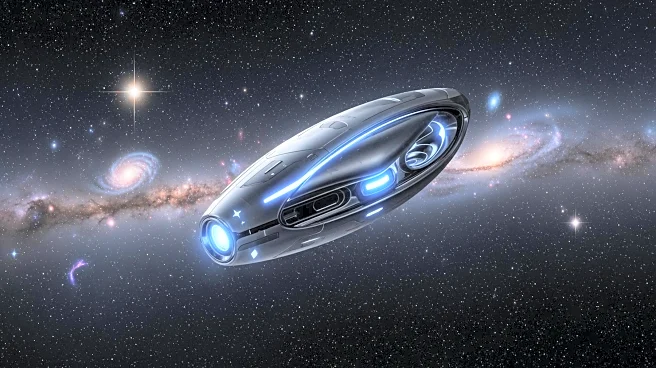
Harvard scientist Avi Loeb has proposed that interstellar objects such as 3I/ATLAS could be of alien origin, potentially sent by advanced civilizations to 'seed' life on Earth. Loeb's theory challenges NASA's classification of ATLAS as a comet, suggesting
instead that its characteristics might indicate artificial origins. He argues that Earth has likely been visited by extraterrestrial civilizations, given the statistical improbability of Earth being isolated from its galactic environment over its 4.6 billion-year history. Loeb points out that interstellar objects have only been detected in the past decade, with 3I/ATLAS being the third recorded instance, following 1I/ʻOumuamua in 2017 and 2I/Borisov in 2019.
Why It's Important?
Loeb's hypothesis raises significant questions about the potential for extraterrestrial life and the origins of life on Earth. If interstellar objects like 3I/ATLAS are indeed artificial, it could imply that advanced civilizations have been monitoring or influencing Earth for billions of years. This perspective challenges current scientific understanding and could impact future space exploration priorities. Loeb suggests reallocating military budgets towards space exploration to better understand these phenomena, which could inspire humanity to pursue interplanetary travel and avoid potential self-destruction.
What's Next?
The scientific community may further investigate the nature of interstellar objects like 3I/ATLAS to determine their origins. This could involve enhanced monitoring technologies and international collaboration in space research. Loeb's call for increased investment in space exploration might influence policy discussions, potentially leading to a shift in funding priorities. The possibility of discovering extraterrestrial life could also spark public interest and debate about humanity's place in the universe.
Beyond the Headlines
Loeb's theory touches on broader philosophical and existential questions about humanity's role in the cosmos. It challenges the notion of Earth as an isolated entity and suggests a more interconnected galactic history. This perspective could influence cultural and scientific narratives, encouraging a reevaluation of human history and our future trajectory. The ethical implications of potentially encountering extraterrestrial civilizations also warrant consideration, as they could redefine humanity's understanding of intelligence and life.