



What's Happening?
The National Institutes of Health (NIH) has awarded $57.5 million to Boston University’s National Emerging Infectious Diseases Laboratories (NEIDL). This five-year grant, provided by the National Institute of Allergy and Infectious Diseases, is intended
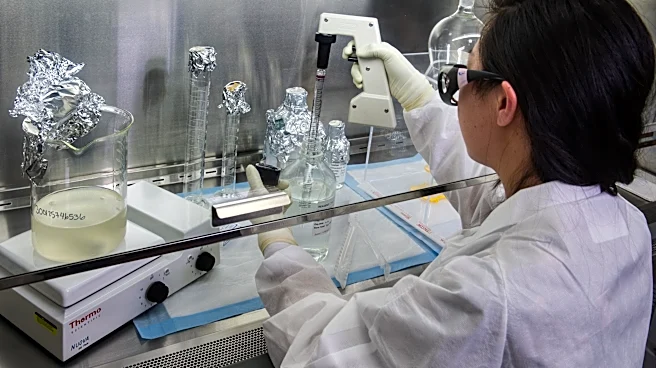
to support NEIDL's mission to understand and combat major threats to domestic and global health. The funding will directly cover the lab's operations, including biosecurity systems, biosafety programs, facility maintenance, regulatory compliance, specialized biocontainment training, and advanced technical research support services. NEIDL, one of only two national biocontainment labs in the United States, operates at Biosafety Level 4 (BSL-4), enabling researchers to study highly dangerous pathogens such as Ebola, Marburg, Zika, and SARS-CoV-2 in a secure environment. This award follows a previous $7.5 million NIH grant in 2024 for facility modernization.
Why It's Important?
This significant NIH award underscores the critical role of NEIDL in national biodefense and public health preparedness. The funding ensures the continued operation and advancement of a vital research facility dedicated to understanding and developing countermeasures against emerging infectious diseases. By supporting high-containment research, the grant directly contributes to the development of new diagnostics, vaccines, and treatments for pathogens that pose substantial threats to Americans and the global population. The investment reinforces Boston University's capacity for complex, national-scale research and positions the U.S. to better respond to future pandemics and outbreaks. It also highlights the importance of sustained federal funding for specialized research infrastructure, which is essential for maintaining a leading edge in infectious disease research and protecting public health.
What's Next?
The $57.5 million funding will enable NEIDL to continue its ongoing research into priority pathogens and expand its efforts in developing new medical interventions. Researchers at NEIDL will proceed with studies on diseases like Ebola, dengue, and other mosquito-borne viruses, aiming to translate scientific discoveries into practical applications. The lab will also continue to serve as a national resource, attracting scientists and healthcare companies for collaborative research. The sustained funding is expected to strengthen the U.S.'s overall biodefense capabilities and enhance its readiness for future health crises. Continued support from federal agencies like the NIH will be crucial for NEIDL to maintain its operational excellence and contribute to global health security.
Beyond the Headlines
The substantial investment in NEIDL reflects a broader national strategy to bolster defenses against biological threats, a priority amplified by recent global health crises. The existence of BSL-4 facilities like NEIDL is not only about immediate disease response but also about fostering a long-term scientific ecosystem capable of anticipating and mitigating future biological risks. This funding also highlights the intricate relationship between academic institutions, federal agencies, and the private sector in addressing complex public health challenges. The continuous need for such high-level biocontainment research also raises ethical considerations regarding the safe handling of dangerous pathogens and the public's trust in such facilities, emphasizing the importance of stringent oversight and transparent communication in biodefense efforts.