







What's Happening?
The U.S. Navy and the Royal Navy are preparing for 'Atlantic Thunder 26' (AT26), a multi-domain exercise scheduled for September 17-21 in waters off the QinetiQ Hebrides range in north-west Scotland. The central event of AT26 will be a sinking exercise (SINKEX),
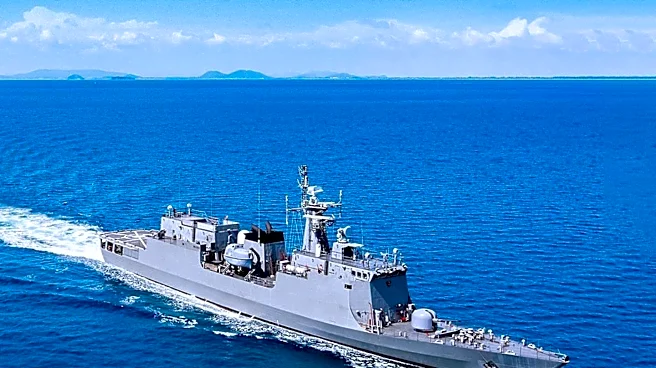
where British and American air and naval forces will conduct coordinated attacks against the decommissioned Oliver Hazard Perry-class frigate, USS Klakring. The USS Klakring, decommissioned in 2013 and stored at the Philadelphia Naval Inactive Ship Maintenance Facility, was towed down the Delaware River on August 12 in preparation for its transatlantic voyage. This exercise aims to validate surface weapon kill chains, build resilient kill webs, and deliver strategic messaging through kinetic demonstration. A similar exercise occurred in September 2022, involving the sinking of the former USS Boone. Environmental regulations require the removal of hazardous materials from vessels before deliberate sinking, a process that can be costly.
Why It's Important?
This joint exercise is significant for several reasons. For the U.S. Navy, it continues a tradition of large-scale SINKEX events, which are crucial for validating combat effectiveness and projecting a clear message of deterrence to potential adversaries. The exercise allows both navies to test and refine their weapon systems and targeting networks in a demanding live environment, enhancing interoperability and readiness. The involvement of uncrewed systems for target acquisition and remote underwater surveys of the wreck signifies a commitment to advancing emerging technologies in naval warfare. This collaboration strengthens the alliance between the U.S. and the UK, demonstrating a united front in maritime security and defense capabilities. The data gathered from the wreck survey will be vital for evaluating weapon effectiveness and the potential of new survey technologies, contributing to future naval strategies and technological advancements.
What's Next?
Following the towing of the USS Klakring across the Atlantic, the vessel will be positioned for the AT26 exercise in September. During the exercise, British and American forces will execute coordinated attacks, culminating in the sinking of the frigate. Post-sinking, the Royal Navy plans to deploy Uncrewed Underwater Vehicles (UUVs) to conduct surveys of the wreck. These UUVs will gather high-resolution imagery and data to assess the effectiveness of the weapons used and the capabilities of new survey technologies. This data will also contribute to advancing concepts of interoperability and interchangeability with the U.S. Navy in uncrewed underwater operations. The exercise will serve as a development platform for emerging technologies, with potential future implications for naval tactics and equipment procurement for both nations.
Beyond the Headlines
The AT26 exercise, while primarily a military drill, carries deeper implications for international relations and technological development. The decision to use a decommissioned U.S. Navy vessel for the SINKEX, rather than one of the Royal Navy's own plentiful decommissioned warships, highlights the logistical and financial considerations involved in such operations, particularly regarding environmental regulations for hazardous material removal. The emphasis on uncrewed systems and remote surveys points to a broader trend in modern warfare towards automation and data-driven decision-making, potentially reducing human risk in dangerous environments. This exercise also underscores the ongoing strategic importance of transatlantic alliances in maintaining global security and projecting military power, serving as a deterrent message in an increasingly complex geopolitical landscape. The continuous validation of combat effectiveness through such live-fire exercises is crucial for maintaining military superiority and adapting to evolving threats.