
What's Happening?
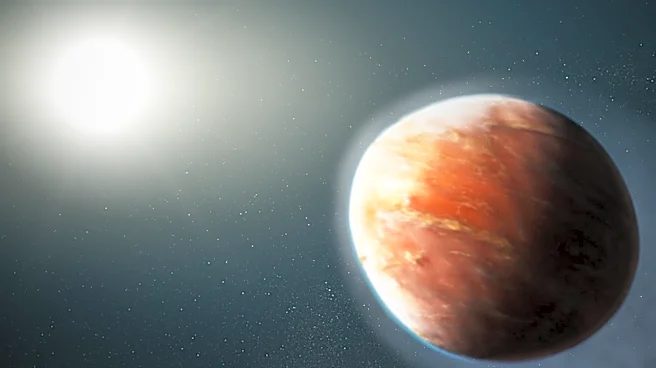
Astronomers have detected an atmosphere on LHS 1140 b, a rocky exoplanet located 48 light-years from Earth, marking a significant milestone in the search for life beyond our solar system. The discovery
was made by observing helium escaping from the planet's atmosphere, indicating that it has retained its atmosphere for over three billion years. LHS 1140 b orbits within the habitable zone of its star, where conditions could allow for liquid water. This finding provides strong evidence that Earth-like planets with atmospheres exist outside our solar system, potentially capable of supporting life.
Why It's Important?
The detection of an atmosphere on LHS 1140 b is crucial for understanding the potential for life on other planets. It demonstrates that rocky planets in habitable zones can maintain atmospheres over long periods, a key factor for habitability. This discovery opens new avenues for studying exoplanets and their potential to support life, influencing future astronomical research and exploration. It also enhances our understanding of planetary formation and atmospheric retention, contributing to the broader field of astrobiology.
What's Next?
Researchers plan to further study LHS 1140 b to determine its atmospheric composition and assess its habitability. The findings will guide future observations and the search for similar exoplanets. Ground-based observatories may use the techniques developed in this study to investigate other rocky planets. The ongoing research will focus on identifying planets with conditions suitable for life, potentially leading to groundbreaking discoveries in the field of exoplanetary science.