
What's Happening?
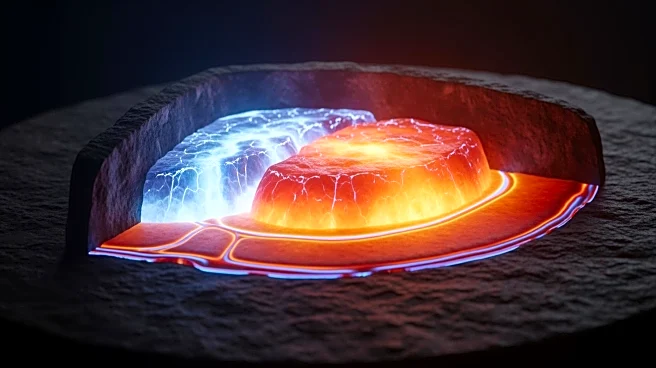
Recent research has uncovered thermally-insulating patches at the base of Earth's mantle, known as ultralow velocity zones (ULVZs). These small-scale structures, located above the core-mantle boundary,
exhibit lower seismic velocities and higher density compared to surrounding mantle materials. The study, led by Prof. Wen-Pin Hsieh, utilized ultrafast optical spectroscopy and high pressure-temperature diamond anvil cells to measure the thermal conductivity of iron-rich magnesiowüstite, a candidate material for ULVZs. The findings reveal that these patches act as thermal insulation, significantly affecting heat transfer from the core to the mantle.
Why It's Important?
The discovery of ULVZs and their insulating properties has profound implications for understanding Earth's thermochemical evolution and the operation of its magnetic field. By impeding heat transfer, these structures can alter the distribution of heat flux across the core-mantle boundary, potentially influencing the geodynamo that generates Earth's magnetic field. This research advances our knowledge of deep Earth processes and highlights the complexity of interactions at the core-mantle boundary, which are crucial for understanding the planet's thermal and magnetic history.