








What's Happening?
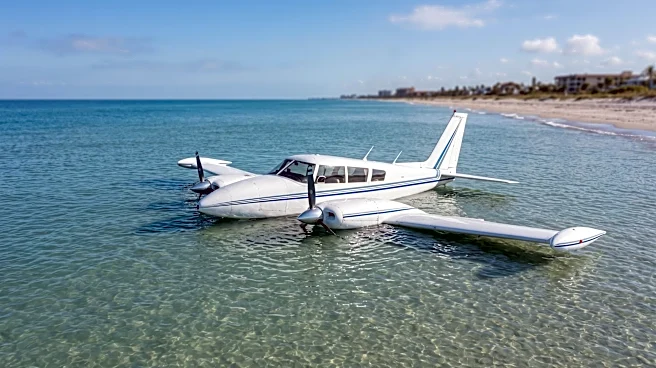
On Saturday morning, a 23-year-old pilot, Faith Tenkley, successfully crash-landed a Piper PA30 series twin-engine propeller plane in the shallow ocean off Boca Raton beach, Florida, after experiencing mechanical issues. The plane had departed from Page
Field in Fort Myers, en route to South Bimini Airport in the Bahamas, when Tenkley encountered problems approximately 15 miles west of Boca Raton. She reported that the right engine failed and the landing gear broke. Despite being cleared to land at Boca Raton Airport, Tenkley, fearing a fire due to the plane's full fuel tanks, opted for a water landing. She skillfully dodged buildings and paddleboarders to find an empty spot for a smooth descent. No injuries were reported from the incident. On Sunday morning, crews were observed removing the plane from the water near South Beach Park and loading it onto a semi-truck.
Why It's Important?
This incident highlights the critical importance of pilot training, quick decision-making, and emergency procedures in aviation. Faith Tenkley's ability to safely land a disabled aircraft in a populated coastal area without causing any injuries or significant damage to property, beyond the plane itself, is a testament to her skill and composure under pressure. The event also underscores the inherent risks associated with general aviation and the need for rigorous maintenance and pre-flight checks. For coastal communities, such incidents raise awareness about emergency response capabilities, involving agencies like Boca Raton Ocean Rescue and the Boca Raton Police Department, and their coordination in managing unexpected events that could impact public safety and environmental concerns, such as potential fuel spills.
What's Next?
The Federal Aviation Administration (FAA) will likely conduct a thorough investigation into the mechanical failure of the Piper PA30 series twin-engine propeller plane. This investigation will aim to determine the exact cause of the engine failure and landing gear malfunction, which could lead to recommendations for aircraft maintenance, manufacturing, or operational procedures. The pilot, Faith Tenkley, will likely cooperate with authorities, providing her account of the events. The removal of the plane from the water is a preliminary step, and further assessment of the aircraft's damage will be conducted. The incident may also prompt local authorities to review emergency response protocols for similar events in coastal areas, ensuring efficient and safe handling of future occurrences.
Beyond the Headlines
Beyond the immediate safety concerns, this incident touches upon the broader narrative of human resilience and the psychological impact of near-catastrophic events. The pilot's decision to prioritize a water landing over a potentially more dangerous airport landing, despite being cleared, reflects a deep understanding of risk assessment and a commitment to public safety. This event could serve as a case study in aviation safety training, emphasizing the value of practical judgment over strict adherence to protocols when unforeseen circumstances arise. It also subtly highlights the increasing presence of small aircraft in recreational and private travel, bringing into focus the need for continuous advancements in aircraft reliability and emergency preparedness in an increasingly crowded airspace and coastal environment.