








What's Happening?
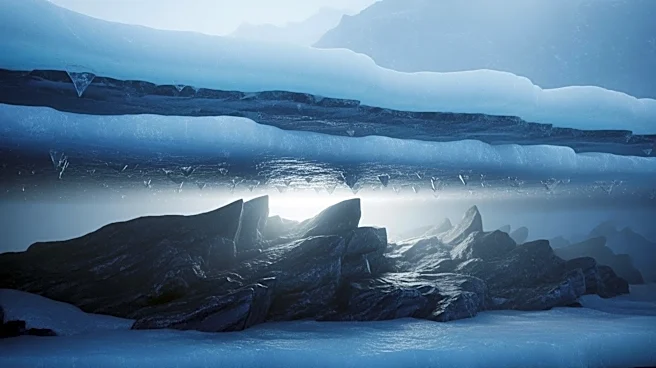
An international team of researchers has uncovered a massive geological formation beneath East Antarctica, revealing a continent-scale structure buried under thick ice. This discovery, made by scientists from the University of Cambridge's Department of Geography,
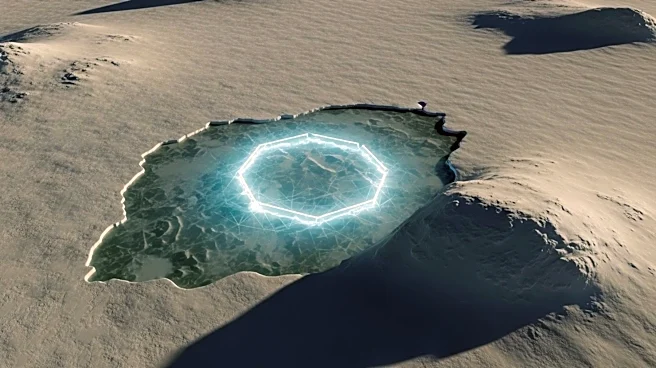
shows that several well-known subglacial basins are interconnected as part of a single enormous system. The newly identified feature, named the East Antarctic Fan-shaped Basin Province, consists of a network of huge basins concealed beneath the East Antarctic Ice Sheet. These basins form a vast fan-shaped pattern across a large portion of the continent, including the Wilkes Basin, the Aurora Basin, and the basin containing Lake Vostok. The research suggests the formation developed through a mechanism known as distributed rotational extension, which involves the continental crust stretching outward from a central location.
Why It's Important?
The discovery of this hidden structure is significant as it provides new insights into Antarctica's geological past and its role in the evolution of the ancient supercontinent Gondwana. Understanding the formation and development of these basins could help scientists reconstruct Antarctica's distant past and its separation from Australia. Additionally, the shape of the bedrock beneath the ice sheet affects how ice moves across the continent, influencing the stability of parts of the Antarctic Ice Sheet vulnerable to climate change. This finding could have modern-day implications for understanding ice movement and the locations of subglacial lakes and basins, which are crucial for predicting future changes in the Antarctic environment.