

What's Happening?
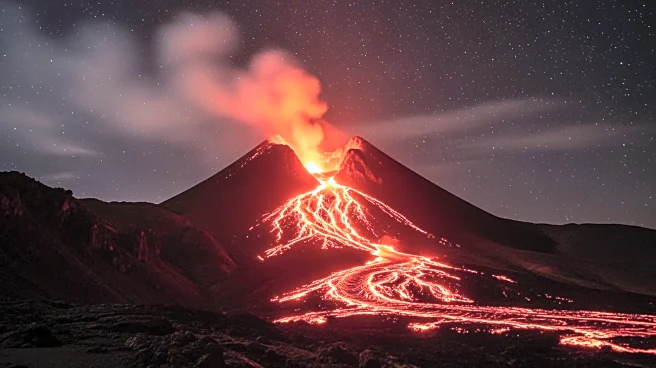
On New Year's Day, Mount Etna in Italy erupted, with a drone capturing stunning footage of lava flowing from a fissure. The eruption is part of Mount Etna's ongoing volcanic activity, which is closely monitored due to its potential impact on nearby communities
and air travel. The footage highlights the natural beauty and power of the volcanic activity, drawing attention from both scientists and tourists. Mount Etna is one of the most active volcanoes in the world, and its eruptions are a regular occurrence, often providing valuable data for volcanic research.
Why It's Important?
Mount Etna's eruptions are significant for both scientific research and public safety. The volcanic activity provides researchers with opportunities to study geological processes and improve understanding of volcanic behavior. This knowledge is crucial for predicting future eruptions and mitigating risks to nearby populations. The eruptions also have implications for air travel, as volcanic ash can disrupt flight paths and airport operations. Additionally, the visual spectacle of the lava flows attracts tourists, contributing to the local economy. However, it also poses risks to those living in proximity to the volcano.
What's Next?
Scientists will continue to monitor Mount Etna's activity closely, using data from the eruption to enhance predictive models and improve safety measures. Local authorities may issue advisories or evacuations if necessary to protect residents and visitors. The eruption could lead to temporary airspace closures or flight diversions, affecting travel plans. Researchers may also use the event to engage the public in educational initiatives about volcanic activity and safety. The ongoing activity of Mount Etna will remain a point of interest for both the scientific community and tourists.