






What's Happening?
Scientists at the University of Texas San Antonio (UTSA) have developed the Genesis 2.0 AI chip, designed to overcome the 'catastrophic forgetting' phenomenon common in current AI systems. This issue prevents AI from retaining previously learned knowledge
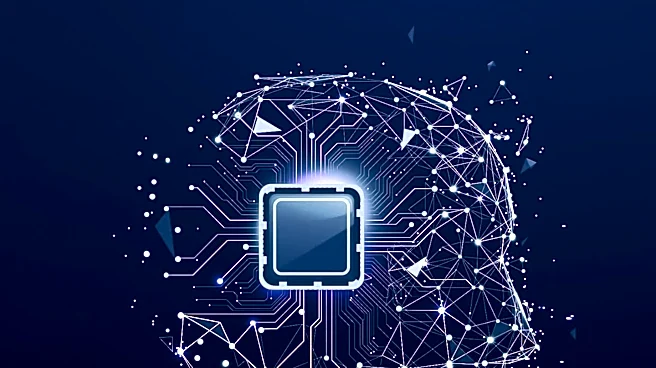
when programmed with new tasks. Dr. Dhireesha Kudithipudi, director of UTSA’s Matrix AI Consortium and the Neuromorphic Artificial Intelligence Laboratory (NUAI) Lab, highlighted the critical need for AI to recall past knowledge, especially in sensitive applications like healthcare and exploration. The Genesis 2.0 chip incorporates a continuous learning software or algorithm, allowing it to learn and retain information throughout its operational life. Its design draws inspiration from the human brain's ability to form connections, utilizing spiking neural networks and features like metaplasticity. The research and development of the chip, which took approximately five years and cost around $2 million, was funded by a grant from the Air Force Research Laboratory (AFLR). The team, including Dr. Nicholas Soures, Dr. Fatima Tuz Zohora, and Dr. Vedant Karia, focused on creating an energy-efficient hardware solution that can offload high-power computations from traditional systems.
Why It's Important?
The development of the Genesis 2.0 AI chip represents a significant advancement in artificial intelligence, addressing a fundamental limitation that has hindered AI's reliability and applicability in critical real-world scenarios. By enabling continuous learning and preventing 'catastrophic forgetting,' the chip can ensure that AI systems maintain a comprehensive knowledge base, leading to more consistent and safer decision-making. This is particularly crucial for U.S. industries such as healthcare, where AI could assist in diagnostics and treatment, and in robotics for defense and exploration, where adaptability and memory are paramount. The chip's low-power design also offers substantial energy efficiency benefits, reducing operational costs and environmental impact for AI-driven applications. Furthermore, the funding from the Air Force Research Laboratory underscores the strategic importance of this technology for national security and defense, potentially leading to more robust and autonomous systems for military and intelligence operations. The innovation could also spur further research and development in neuromorphic computing, positioning the U.S. at the forefront of next-generation AI hardware.
What's Next?
While the Genesis 2.0 chip is not yet ready for mainstream deployment, the research team indicates that several more steps are required before it can be fully integrated into real-world applications. The next phase will likely involve further testing, refinement, and scaling of the technology to ensure its robustness and compatibility with various devices. The team envisions the chip being connected to diverse devices, including healthcare equipment and robotics, acting as a low-power accelerator. Continued collaboration with industry partners and further investment will be crucial for transitioning the Genesis 2.0 from a research prototype to a commercially viable product. The success of this chip could also influence future AI chip design, encouraging a shift towards brain-inspired architectures that prioritize continuous learning and energy efficiency. Additionally, the Air Force Research Laboratory's continued interest suggests potential future applications in defense and aerospace, driving further development and integration into specialized systems.
Beyond the Headlines
The Genesis 2.0 AI chip's ability to mimic the human brain's learning and memory functions opens up profound ethical and philosophical discussions about the nature of artificial intelligence. Overcoming 'catastrophic forgetting' brings AI closer to human-like cognitive processes, raising questions about the long-term implications of creating machines that can continuously learn and adapt without losing past knowledge. This development could lead to AI systems with unprecedented autonomy and decision-making capabilities, necessitating careful consideration of accountability and control mechanisms. Legally, the deployment of such advanced AI in critical sectors like healthcare and defense will require new regulatory frameworks to address potential risks and ensure responsible use. Culturally, a continuously learning AI could reshape human-technology interaction, fostering deeper integration of AI into daily life and potentially altering societal expectations of machine intelligence. The emphasis on energy efficiency also highlights a broader shift in the tech industry towards sustainable computing, addressing the environmental impact of increasingly powerful AI systems.