
What's Happening?
Researchers at Auburn University have identified a distinctive ultraviolet signature of water in the interstellar comet known as 3I/ATLAS. This comet, only the third known interstellar comet ever observed,
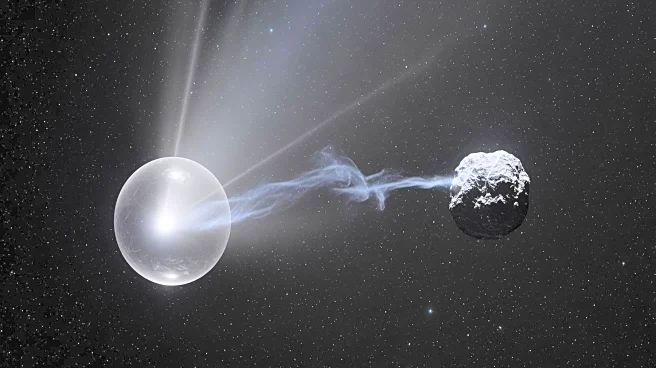
was detected by NASA’s Neil Gehrels Swift Observatory. The observatory captured a faint ultraviolet signal indicating the presence of hydroxyl (OH) gas, a chemical marker of water. This discovery marks a significant advancement in the study of interstellar comets, allowing scientists to evaluate 3I/ATLAS using the same framework applied to solar system comets. The detection of water activity at a distance where it was not expected suggests that sunlight may be warming small icy grains released from the comet's nucleus, allowing them to vaporize and sustain a surrounding cloud of gas.
Why It's Important?
The discovery of water in 3I/ATLAS provides new insights into the chemistry of planetary systems across the galaxy. It suggests that the ingredients for life’s chemistry are not unique to our solar system. The variations in chemical profiles among interstellar comets reveal a wide range of planetary environments beyond our Sun. This finding could reshape our understanding of how planets and comets form around stars, offering clues about the conditions needed for life. The ability to detect such signals from space, free from Earth's atmospheric interference, highlights the potential for small space-based telescopes to contribute significantly to astronomical research.
What's Next?
3I/ATLAS has now faded from view but will become observable again after mid-November, providing another opportunity to track its activity as it approaches the Sun. This ongoing observation will help scientists understand how the comet's activity evolves and further compare it to other comets. The current detection of hydroxyl provides a basis for future studies on interstellar objects, potentially leading to more discoveries about the materials that make up comets and the planetary systems they originate from.