

What's Happening?
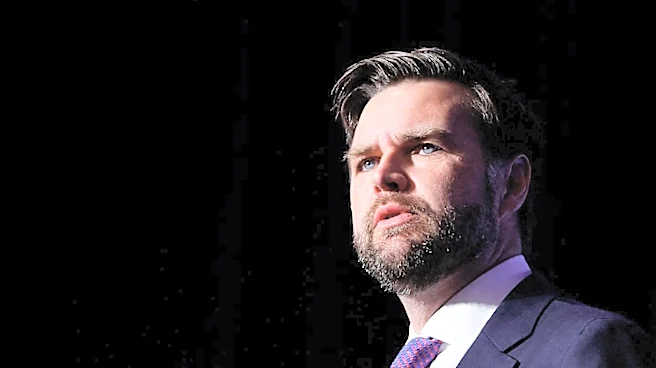
A recent event in Olathe, Kansas, featuring U.S. Vice President JD Vance was interrupted by a protester. Vice President Vance was in the Kansas City metropolitan area on Monday to discuss new anti-fraud operations and to show support for Senator Roger
Marshall. The event, hosted by Make America Great Again Inc., a super political action committee supporting Republican candidates, took place at Webco Manufacturing. During Vance's speech, a protester began shouting comments, though the specific nature of these comments was not immediately clear. Security personnel promptly removed the individual from the venue. Following the protester's removal, Vance supporters initiated a "USA" chant. Vice President Vance acknowledged the interruption, stating that the protester was there to spread falsehoods about Senator Marshall. He also referenced a previous incident where a protester displayed a Mexican flag, implying a clear stance.
Why It's Important?
This incident highlights the increasing polarization and confrontational nature of political discourse in the United States, even at local campaign events. The interruption of a Vice President's speech by a protester, followed by a supportive chant from the audience, underscores the deep divisions within the American public. For political figures like Vice President Vance and Senator Marshall, such events can be a test of their ability to maintain composure and control the narrative amidst opposition. The reference to a protester with a Mexican flag also touches upon sensitive issues of national identity, immigration, and political symbolism, which are frequently debated in U.S. politics. The quick removal of the protester by security reflects the heightened security measures and protocols in place for high-ranking officials, while the audience's reaction demonstrates the strong partisan loyalty prevalent in current political rallies. This type of disruption can also be seen as a tactic to draw media attention to opposing viewpoints, regardless of the specific message conveyed.
What's Next?
In the immediate future, political campaigns and events featuring high-profile figures like Vice President Vance are likely to continue experiencing similar interruptions. Security measures will remain stringent to ensure the safety of speakers and attendees. Campaign strategies may adapt to address or preempt such disruptions, potentially by increasing security presence or by preparing responses to anticipated protests. The incident could also be used by both sides for their respective narratives: supporters might frame it as an attempt to silence their message, while opponents might highlight it as a sign of public discontent. As the political season progresses, the frequency and nature of these confrontations could escalate, further emphasizing the need for campaigns to manage public appearances carefully. The broader implications for political discourse suggest a continued environment where direct challenges to authority figures are becoming more common, requiring politicians to be prepared for immediate, on-the-spot responses.
Beyond the Headlines
Beyond the immediate event, this incident reflects a broader trend of declining civility in public discourse and the increasing use of direct confrontation as a form of political expression. The act of interrupting a speaker, particularly a high-ranking official, can be viewed as a challenge to established norms of political engagement. This trend can contribute to a more fractured society where dialogue is replaced by shouting matches, making it harder to find common ground or engage in constructive debate. The Vice President's response, by directly addressing the protester and referencing a previous incident, also illustrates how political figures are adapting to these new realities, often using such moments to rally their base. The incident also raises questions about the balance between freedom of speech and the right of public officials to conduct events without undue disruption. The symbolism of the Mexican flag, as mentioned by Vance, further complicates the narrative, tapping into deeper cultural and national identity debates that often underpin political disagreements in the U.S.