
What's Happening?
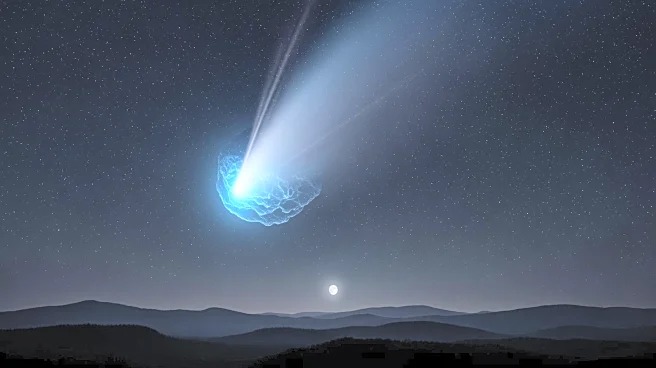
Comet C/2024 E1, also known as Wierzchos, is making its way from the outer regions of the solar system into Earth's skies, providing astronomers and stargazers a unique opportunity to observe this celestial
body. Discovered in March 2024 by the Catalina Sky Survey, the comet is believed to have originated from the Oort Cloud, a distant icy shell surrounding the solar system. The James Webb Space Telescope has observed the comet, noting a deficiency of carbon monoxide in its composition, which may indicate depletion before its formation or expulsion by larger inner planets. The comet is expected to be visible in the southern hemisphere, with astrophotographer Ian Griffin capturing images from New Zealand. It will also be visible in the northern hemisphere, including parts of southern India, around its closest approach to Earth on February 17.
Why It's Important?
The appearance of Comet C/2024 E1 (Wierzchos) is significant for both scientific research and public interest in astronomy. For scientists, the comet offers a chance to study the composition and behavior of celestial bodies originating from the Oort Cloud, potentially providing insights into the early solar system's conditions. The deficiency of carbon monoxide observed by the James Webb Space Telescope could lead to new understandings of cometary evolution and the processes affecting their chemical makeup. For the public, the comet's visibility presents a rare opportunity to witness a distant visitor from the solar system, fostering interest in space exploration and astronomy. This event highlights the importance of ongoing sky surveys and space telescopes in monitoring and understanding near-Earth objects.
What's Next?
As Comet C/2024 E1 (Wierzchos) approaches its closest point to Earth, astronomers and enthusiasts will continue to monitor its trajectory and visibility. Observatories and amateur astronomers are likely to capture more images and data, contributing to a broader understanding of its characteristics. Public interest may lead to increased participation in stargazing events and educational programs, promoting awareness of celestial phenomena. The scientific community will analyze the data collected to refine models of cometary behavior and composition, potentially influencing future research and exploration missions. The comet's journey through the solar system serves as a reminder of the dynamic nature of space and the ongoing need for vigilance in tracking near-Earth objects.