
What's Happening?
In July 2024, a magnitude 7.4 earthquake struck near Calama, Chile, causing significant damage and power disruptions. Unlike typical megathrust earthquakes, this event originated at a depth of 125 kilometers,
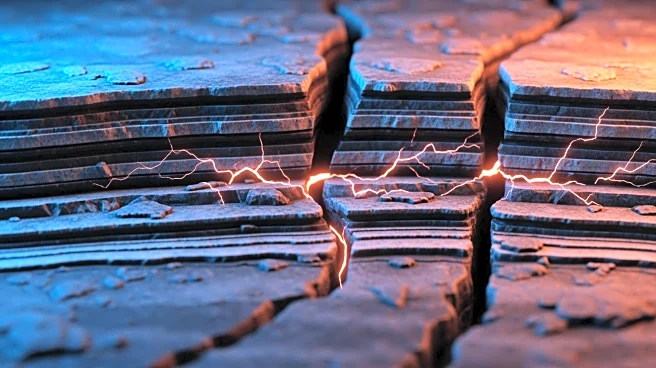
within the subducting tectonic plate. Researchers from The University of Texas at Austin found that a rare sequence of underground processes, including 'thermal runaway,' significantly increased the earthquake's intensity. This discovery challenges previous assumptions about intermediate-depth earthquakes, which were thought to be driven mainly by 'dehydration embrittlement.' The study, published in Nature Communications, aims to improve earthquake hazard assessments.
Why It's Important?
The findings from this research have significant implications for understanding and predicting earthquake behavior, particularly in regions prone to seismic activity like Chile. By identifying the processes that can enhance the intensity of deep earthquakes, scientists can develop better models to forecast seismic risks. This knowledge is crucial for designing infrastructure, improving early warning systems, and planning emergency responses. The study highlights the need for continued research and monitoring to mitigate the impact of future earthquakes, which could save lives and reduce economic losses.
What's Next?
The research team plans to continue studying the mechanisms behind deep earthquakes to refine predictive models. This ongoing work will involve collaboration with international scientists and the deployment of advanced monitoring equipment in seismic regions. The goal is to enhance the accuracy of earthquake forecasts and improve public safety measures. As Chile remains at risk for large earthquakes, these efforts are vital for preparing the country and other seismic-prone areas for potential future events.