
What's Happening?
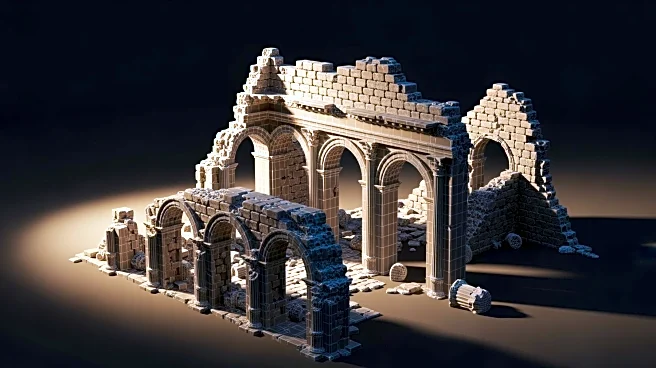
Recent archaeological research has unveiled 'lost' portions of ancient Pompeii using advanced digital reconstructions. The project, a collaboration between the Archaeological Park of Pompeii and Humboldt
University of Berlin, focuses on the House of Thiasus, a large ancient home in Regio IX. The research employs technologies like LiDAR and high-resolution imaging to reconstruct the ancient structures buried by the eruption of Mount Vesuvius in 79 AD. The findings include a grand staircase that likely led to a tower, offering insights into the architectural style and living conditions of Pompeii's elite residents.
Why It's Important?
This research is crucial for understanding the architectural and cultural history of Pompeii, providing a more complete picture of the city before its destruction. The use of digital technology in archaeology allows for the reconstruction of structures that were previously lost, offering new insights into ancient Roman society. The project highlights the potential of modern technology to enhance historical research and preservation efforts. By revealing the architectural complexity of Pompeii, the research contributes to our knowledge of Roman urban planning and the lifestyle of its inhabitants.