





What's Happening?
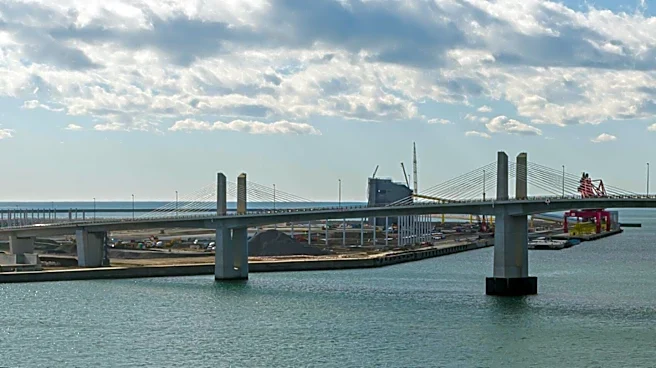
Federal highway officials have granted final environmental approval for the replacement of the Chesapeake Bay Bridge. The Maryland Transportation Authority (MDTA) announced that the project will involve constructing two new four-lane spans, each with
full shoulders, to replace the existing structures. The new spans will feature a vertical clearance of approximately 230 feet above the water, an increase from the current bridge, to accommodate larger ships entering the Port of Baltimore. The estimated cost for the new structures ranges between $14.8 billion and $17.6 billion. Melissa Williams, MDTA’s planning director, indicated that a design team will be assembled shortly, with final design expected to launch in the spring of 2028. Construction could commence as early as the summer of 2032, contingent on various factors. This project will run concurrently with the ongoing replacement of the Francis Scott Key Bridge, which is projected to be completed by the end of 2030.
Why It's Important?
The federal approval for the Chesapeake Bay Bridge replacement marks a critical step forward for a major infrastructure project in Maryland, impacting regional transportation, economy, and maritime commerce. The construction of two new four-lane spans with increased vertical clearance will significantly improve traffic flow, enhance safety for motorists by providing full shoulders, and allow larger vessels to access the Port of Baltimore, boosting its economic competitiveness. The project's substantial cost, estimated between $14.8 billion and $17.6 billion, signifies a massive investment in the state's infrastructure, promising job creation and economic stimulus during its multi-year construction phase. However, the concurrent nature of this project with the Francis Scott Key Bridge replacement will place considerable demands on resources and planning for the MDTA. The long-term benefits include enhanced regional connectivity and economic resilience, but the immediate challenge lies in managing two megaprojects simultaneously.
What's Next?
Following federal environmental approval, the Maryland Transportation Authority (MDTA) will proceed with assembling a design team for the Chesapeake Bay Bridge replacement project. The final design phase is anticipated to begin in the spring of 2028. If all goes according to plan, construction could commence in the summer of 2032. This timeline indicates a prolonged period of planning and development before physical construction begins. Key next steps will involve securing funding, detailed engineering, and potentially further public engagement regarding specific design elements. The MDTA will also need to manage the logistical complexities of designing this megaproject while simultaneously overseeing the ongoing reconstruction of the Francis Scott Key Bridge. Stakeholders, including local communities, environmental groups, and maritime industries, will likely monitor the project's progress closely, particularly concerning its environmental impact during construction and its long-term operational benefits.
Beyond the Headlines
The replacement of the Chesapeake Bay Bridge transcends a mere infrastructure upgrade; it represents a significant adaptation to evolving economic and environmental demands. The increased vertical clearance directly addresses the trend of larger cargo ships, ensuring the Port of Baltimore remains competitive and accessible, which is crucial for regional and national supply chains. This project also highlights the long-term planning required for critical infrastructure, with a construction timeline extending well into the next decade. The decision to replace rather than extensively repair the existing aging structures reflects a strategic shift towards building more resilient and future-proof infrastructure. Furthermore, managing two major bridge reconstruction projects simultaneously (Chesapeake Bay Bridge and Francis Scott Key Bridge) will test the MDTA's capacity and could set new benchmarks for large-scale infrastructure management in the U.S., potentially influencing how other states approach similar challenges with aging transportation networks.