








What's Happening?
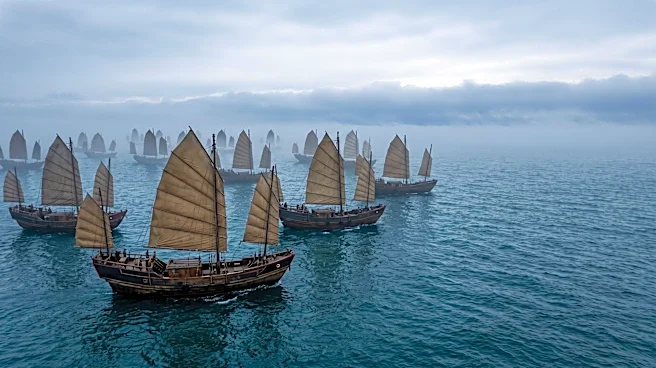
Around 210 BC, a large Chinese fleet, led by court sorcerer Xu Fu, embarked on an expedition from the eastern coast of China. The mission, sanctioned by Emperor Qin Shi Huang, involved approximately sixty ships carrying 6,000 teenagers, soldiers, sailors,
and skilled craftsmen. Their objective was to locate Mount Penglai, a mythical mountain believed to be inhabited by immortals, and retrieve an elixir of life for the emperor. Xu Fu had convinced the emperor that a thousand-year-old magician named Anqi Sheng, possessing the elixir, resided there. The expedition never returned to China, marking one of the oldest genuinely unsolved disappearances in recorded history. Emperor Qin Shi Huang, deeply fearful of death, had invested significant resources into finding ways to extend his life, including consulting alchemists and sorcerers.
Why It's Important?
This ancient expedition highlights the profound human desire for immortality and the lengths to which powerful figures, like Emperor Qin Shi Huang, would go to achieve it. The scale of the undertaking, involving thousands of young people and a diverse group of skilled individuals, suggests a colonial endeavor rather than a mere scouting mission, raising questions about Xu Fu's true intentions or the emperor's understanding of the mission's scope. The disappearance of such a large fleet and its passengers represents a significant historical mystery, with implications for understanding ancient Chinese maritime capabilities, exploration, and the cultural beliefs surrounding life and death. The event also underscores the historical pursuit of longevity, a theme that continues to resonate in modern scientific and philosophical discussions.
What's Next?
While the immediate 'next steps' for an ancient, unsolved disappearance are limited, the narrative continues to evolve through historical interpretation and local traditions. Japanese local traditions, for instance, claim that Xu Fu landed in Japan, with several sites dedicated to him. These traditions suggest he proclaimed himself king and never returned to China, or that he found the elixir from a plant called furofuki. Mainstream historians, however, treat these claims cautiously due to thin archaeological evidence and the late recording of these traditions. The ongoing study of ancient texts, such as the 'Records of the Grand Historian,' and archaeological findings could potentially shed more light on the fate of Xu Fu's fleet and its passengers, offering new perspectives on this enduring historical enigma.
Beyond the Headlines
The story of Xu Fu's expedition delves into deeper implications concerning the intersection of power, belief, and exploration in ancient civilizations. The emperor's obsessive fear of death, coupled with the influence of court sorcerers, illustrates how personal anxieties can drive monumental, resource-intensive undertakings. The expedition's potential as a colonization effort, rather than a simple quest for an elixir, suggests a more complex geopolitical motivation, possibly involving the expansion of Chinese influence or the establishment of new settlements. Furthermore, the enduring nature of the mystery and the development of local legends in Japan highlight the human tendency to create narratives to fill historical voids, blending fact with folklore. This historical event serves as a testament to the persistent human quest for the unknown and the imaginative ways societies have grappled with mortality.