
What's Happening?
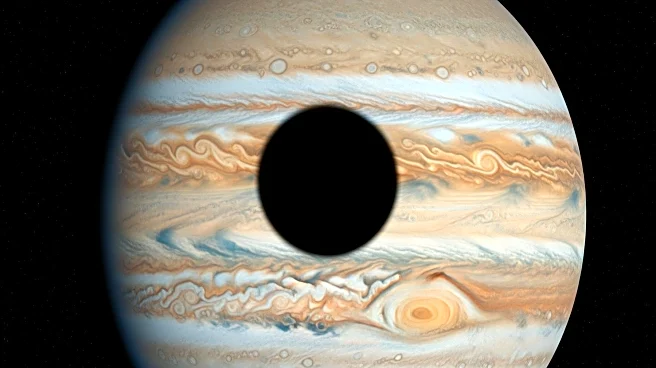
Jupiter's largest moon, Ganymede, is set to transit across the face of the gas giant, providing a captivating event for astronomers and sky watchers. The transit begins at 12:34 A.M. EST on January 14,
2026, and lasts for nearly three hours. During this time, Ganymede's shadow will also be visible on Jupiter's cloud tops, creating a striking visual effect. The event concludes with the shadow disappearing around 4:20 A.M. EST. This celestial occurrence is part of a series of transits involving Jupiter's moons, with Ganymede's larger orbit causing its shadow to appear later than that of Io, another of Jupiter's moons.
Why It's Important?
The transit of Ganymede across Jupiter is significant for both amateur and professional astronomers as it provides an opportunity to observe the dynamics of Jupiter's moons and their interactions with the planet. Such events help in understanding the gravitational influences and orbital mechanics within the Jovian system. For the public, it offers a chance to engage with astronomy and appreciate the complexities of our solar system. The visibility of the event across the U.S. makes it accessible to a wide audience, potentially inspiring interest in space science and observation.
What's Next?
Following Ganymede's transit, astronomers will continue to monitor Jupiter and its moons for further celestial events. These observations contribute to ongoing research into the behavior of planetary systems. For enthusiasts, the next opportunity to observe a similar event will be eagerly anticipated, with telescopes and binoculars ready for action. Educational institutions and observatories may organize viewing events to capitalize on public interest and promote science education.