
What's Happening?
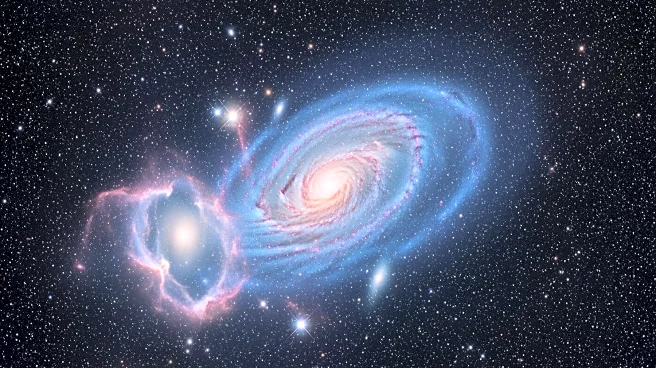
The Hubble Space Telescope, a joint project of NASA and the European Space Agency, has captured a new image of the spiral galaxy NGC 1792. Located over 50 million light-years away in the constellation
Columba, this galaxy is characterized by its bright center and flocculent spiral arms. NGC 1792 is classified as a starburst galaxy, indicating a high rate of star formation. The gravitational interaction with its larger neighbor, NGC 1808, is believed to have triggered this star formation. The new image includes data collected throughout 2025, highlighting the galaxy's active regions where new stars are forming.
Why It's Important?
The study of NGC 1792 provides valuable insights into the processes of star formation and the dynamics of spiral galaxies. Understanding these processes helps astronomers learn more about the life cycles of galaxies and the role of gravitational interactions in triggering star formation. The data from Hubble's observations contribute to the broader field of astrophysics by offering a clearer picture of how galaxies evolve over time. This research can also inform future studies of similar galaxies and enhance our understanding of the universe's structure.