



What's Happening?
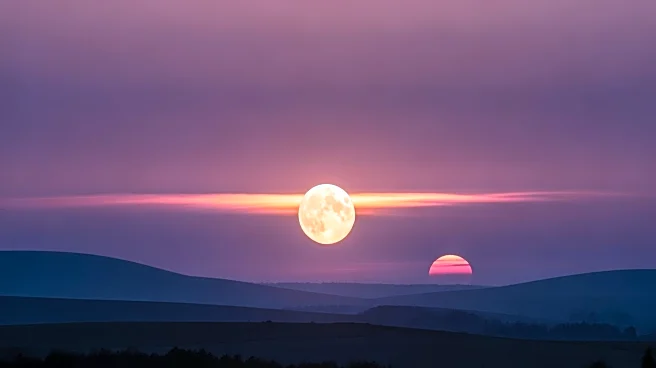
On March 3, a rare celestial event known as a selenelion will occur, allowing observers to see the rising sun and a total lunar eclipse simultaneously. This phenomenon, traditionally deemed impossible, is made visible due to atmospheric refraction, which
causes the sun and moon to appear higher in the sky than they actually are. The total lunar eclipse will be visible across various regions, with the best views in the Eastern Time Zone of North America. The eclipse will begin at 3:03 a.m. PST, lasting 59 minutes, with the moon passing through the Earth's shadow.
Why It's Important?
This event offers a unique opportunity for skywatchers and astronomers to observe a rare alignment of celestial bodies. The selenelion challenges traditional astronomical understanding, providing insights into atmospheric refraction and its effects on celestial observations. For the general public, it presents a chance to engage with astronomy and appreciate the complexities of celestial mechanics. The event could also inspire educational initiatives and public interest in space science.
What's Next?
Observers interested in witnessing the selenelion should ensure clear views of both the eastern and western horizons. The event's visibility will depend on local weather conditions and atmospheric clarity. Astronomers and enthusiasts may use this opportunity to gather data on atmospheric refraction and its impact on celestial observations. Public interest generated by the event could lead to increased participation in future astronomical events and educational programs.