







What's Happening?
The Commission for the Conservation of Antarctic Marine Living Resources (CCAMLR) concluded its 2026 annual meeting in Hobart, Tasmania, without reaching a consensus on establishing new Marine Protected Areas (MPAs) in the Southern Ocean or implementing
revised management measures for the Antarctic krill fishery. This marks the tenth consecutive year that CCAMLR has failed to designate a new MPA. Despite constructive discussions and proposals, including a new MPA proposal from China and continued advocacy for the Domain 1 MPA by Argentina and Chile, no binding protection measures were adopted. The CCAMLR operates on a consensus-based decision-making system, meaning a single objection can prevent the adoption of proposed measures. However, an intersessional process has been agreed upon to continue negotiations on the proposed Domain 1 MPA around the Antarctic Peninsula and a revised krill fishery management regime, aiming for potential adoption at CCAMLR-46 in 2027.
Why It's Important?
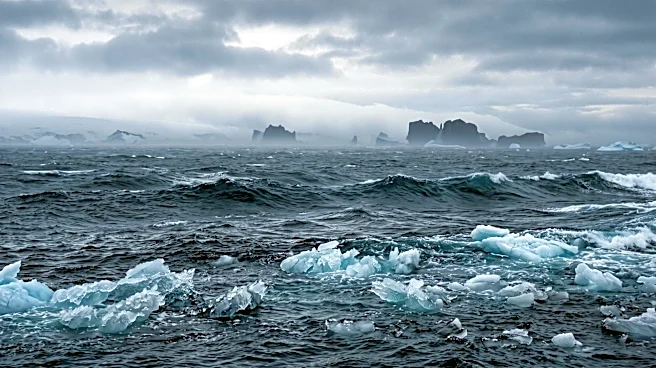
The failure to establish new MPAs and strengthen krill fishery management in the Southern Ocean has significant implications for global marine conservation and the delicate Antarctic ecosystem. The Southern Ocean is crucial for global climate regulation and nutrient distribution, and its protection is vital for the health of the wider planet. Antarctic krill form a central component of the Southern Ocean food web, supporting numerous marine species like penguins, seals, and whales. Without enhanced protection, these polar ecosystems remain vulnerable to the accelerating impacts of climate change and concentrated fishing efforts. The ongoing deadlock undermines international commitments, such as the Kunming-Montreal Global Biodiversity Framework's target to protect 30 percent of the world's land and ocean by 2030. The lack of agreement also raises concerns about the effectiveness of consensus-based decision-making in addressing urgent environmental challenges.
What's Next?
The immediate next step involves an intersessional process where member governments will continue discussions on the proposed Domain 1 MPA and the revised krill fishery management regime. This process aims to build on the negotiating momentum from the 2026 meeting and identify common ground before CCAMLR-46 in 2027. Conservation advocates, such as Antarctica2030, are calling for governments to engage at the highest political levels during the coming year to resolve outstanding differences. Former United States Secretary of State John Kerry emphasized the need for sustained diplomacy over the next twelve months to translate the progress made in discussions into formal agreements. The success of these continued negotiations will determine whether CCAMLR can fulfill its conservation mandate and contribute meaningfully to global biodiversity targets.
Beyond the Headlines
The persistent inability of CCAMLR to reach consensus on critical conservation measures highlights a broader challenge in international environmental governance: balancing economic interests with ecological preservation, especially within a consensus-driven framework. The decade-long impasse underscores the difficulty of achieving multilateral agreement when diverse national interests are at play. This situation also brings into focus the ethical responsibility of nations to protect shared global commons, particularly vulnerable ecosystems like the Antarctic. The outcome of these negotiations will serve as a test case for international cooperation in a fragmented world, demonstrating whether political will can overcome geopolitical differences to address urgent environmental crises. The long-term implications could include further degradation of Antarctic marine habitats and a potential decline in krill populations, impacting the entire Southern Ocean food web and global ecological balance.