



What's Happening?
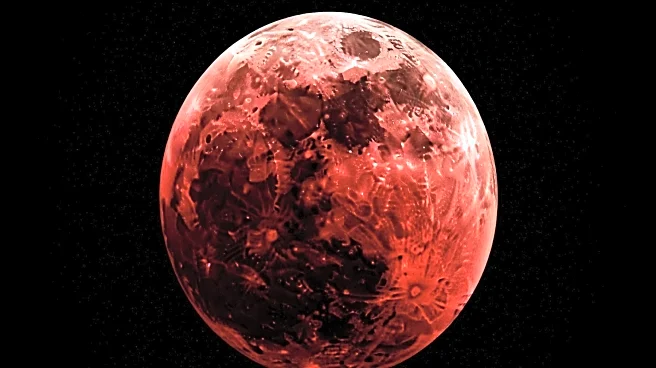
A total lunar eclipse, visible to over three billion people globally, occurred on a recent Tuesday morning, transforming the moon into a striking blood-red hue. This celestial event, often described as the projection of all the world's sunrises and sunsets
onto the moon, was best viewed in North America from the western regions, including Las Vegas. The phenomenon was also visible across parts of Australia, New Zealand, South America, Asia, and Europe, with many setting alarms to witness the spectacle. In Las Vegas, the iconic Sphere was illuminated to resemble a giant Blood Moon, enhancing the visual experience for onlookers. The eclipse lasted approximately 59 minutes, during which the moon was bathed in the red-orange light refracted through Earth's atmosphere.
Why It's Important?
The total lunar eclipse is significant as it offers a rare opportunity for millions to engage with astronomical phenomena, fostering interest in science and space exploration. Such events can inspire educational initiatives and public interest in astronomy, potentially influencing future scientific endeavors and funding. The widespread visibility of the eclipse across multiple continents underscores the global nature of astronomical events, uniting diverse populations in a shared experience. Additionally, the event highlights the importance of preserving dark skies and reducing light pollution to ensure future generations can enjoy similar celestial spectacles.
What's Next?
Following the eclipse, astronomers and enthusiasts may analyze data collected during the event to enhance understanding of lunar and atmospheric sciences. Educational institutions might leverage the public's heightened interest to promote astronomy-related programs and activities. Future lunar eclipses are anticipated, with astronomers already predicting dates and visibility regions, allowing enthusiasts to plan for upcoming celestial events. The continued interest in such phenomena could drive technological advancements in telescopic and imaging equipment, further enriching the field of astronomy.