






What's Happening?
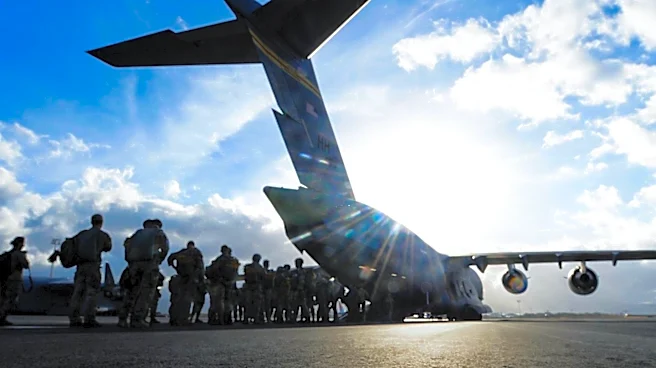
Romania is actively pursuing a stronger U.S. military presence within its borders, viewing it as a critical investment in national security and a deterrent on NATO's eastern flank. The Administration of the President of Romania announced this after a meeting
of the Supreme Council of National Defence, where discussions focused on the current status and future steps in bilateral dialogue regarding U.S. troop presence and capabilities. Concurrently, Bucharest is preparing to update its support for U.S. forces as a host nation, adapting to their operational and logistical needs, with specific parameters being worked out at an interagency level. The Council also approved a plan to equip the Romanian Armed Forces for 2027–2036 and a broader Programme for the Transformation, Development, and Equipping of the Romanian Army through 2044, which includes supporting the national defense industry and procuring new military capabilities.
Why It's Important?
Romania's push for a stronger U.S. military presence directly impacts U.S. foreign policy and defense strategy in Europe. An increased U.S. footprint in Romania would bolster NATO's eastern flank, enhancing deterrence against potential adversaries and reinforcing regional stability. For the U.S., this represents an opportunity to strengthen alliances and project power in a strategically vital area, particularly given ongoing geopolitical tensions. It also signifies a commitment from a key NATO ally to contribute to collective security, potentially sharing the burden of defense. Economically, an increased U.S. military presence could lead to infrastructure investments and logistical contracts, benefiting local economies in Romania. However, it also entails financial and resource commitments for the U.S., requiring careful consideration of strategic priorities and resource allocation within the broader European defense framework.
What's Next?
Bucharest will continue interagency efforts to finalize the specific parameters for supporting an increased U.S. military presence, with practical decisions expected to follow. This will likely involve detailed negotiations and agreements between the U.S. and Romanian governments regarding troop numbers, basing rights, logistical support, and cost-sharing. Concurrently, Romania will proceed with the implementation of its approved long-term defense plans, including the procurement of new military capabilities and the development of its national defense industry. This could lead to new contracts for defense manufacturers, potentially including U.S. companies. The U.S. will need to assess its military presence in Europe in light of Romania's request, balancing its global commitments with the strategic importance of the Black Sea region and NATO's eastern flank. This ongoing dialogue will shape the future of U.S.-Romania defense cooperation and the broader security landscape in Eastern Europe.
Beyond the Headlines
Romania's proactive stance in seeking a stronger U.S. military presence reflects a deeper geopolitical anxiety within Eastern Europe, particularly in the wake of regional conflicts. This move is not merely about military hardware but also about a psychological and political commitment from a powerful ally. It underscores the enduring relevance of traditional alliances in an era of shifting global power dynamics. The emphasis on developing a national defense industry and procuring new military capabilities also points to a broader trend among European nations to enhance their self-reliance in defense, potentially reducing long-term dependence on external powers. This could lead to a more balanced burden-sharing within NATO, but also raises questions about the potential for an arms race in the region. The long-term implications include a potentially more integrated and robust European defense, but also the risk of escalating tensions with neighboring powers if not managed carefully through diplomatic channels.