







What's Happening?
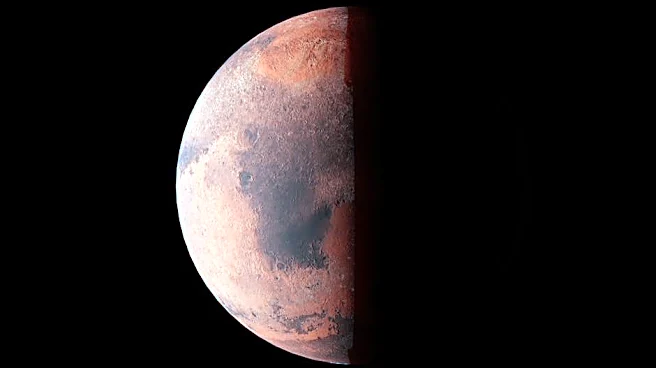
NASA's Psyche probe is set to perform a gravity assist maneuver by passing close to Mars, which will help propel it towards its ultimate destination, a metal-rich asteroid named Psyche. Launched in October 2023, the spacecraft is on a 2.2 billion-mile
journey to the asteroid belt between Mars and Jupiter. The flyby, occurring at a distance of 2,800 miles from Mars, will allow the probe to conserve its xenon gas propellant by using the planet's gravitational pull to adjust its trajectory. This maneuver is part of a broader mission to study the asteroid, believed to be the remnant core of an ancient protoplanet, which is composed largely of metals such as iron, nickel, and gold. The mission aims to provide insights into the formation of Earth and other rocky planets.
Why It's Important?
The Psyche mission is significant as it represents a pioneering effort to study a metallic asteroid up close, potentially offering new insights into planetary formation. Understanding the composition and characteristics of Psyche could shed light on the processes that shaped the early solar system. The mission also demonstrates the innovative use of solar-electric ion thrusters, marking a technological advancement in space exploration. The asteroid's estimated value of 10 quadrillion dollars highlights the potential for future space mining, although this mission is purely scientific. The data collected could influence future missions and the development of technologies for exploring and utilizing space resources.
What's Next?
Following the Mars flyby, the Psyche probe is expected to reach its asteroid target by August 2029. Once there, it will orbit the asteroid for 26 months, conducting detailed studies of its gravity, magnetic properties, and composition. The mission will conclude in 2031 after the spacecraft spirals closer to the asteroid. The success of this mission could pave the way for future explorations of similar celestial bodies, potentially leading to new scientific discoveries and technological advancements in space exploration.
Beyond the Headlines
The Psyche mission also raises questions about the ethical and legal implications of space exploration and resource utilization. As interest in space mining grows, international regulations and agreements may need to be developed to address ownership and environmental concerns. Additionally, the mission underscores the importance of international collaboration in space exploration, as the data and findings could benefit scientists and researchers worldwide.