







What's Happening?
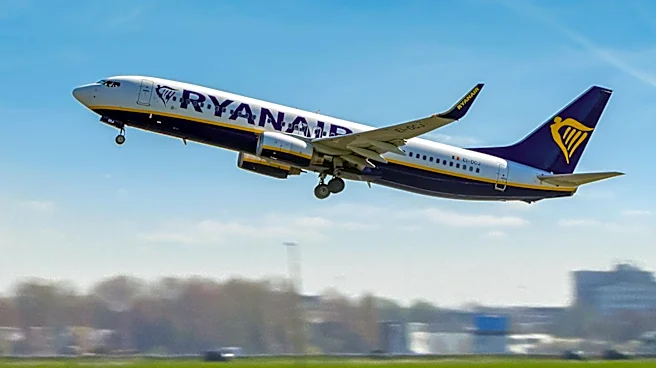
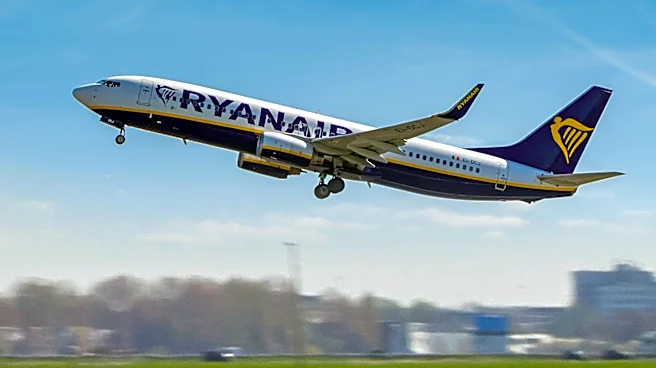
Italian investigators have concluded that a Ryanair Boeing 737 Max 8-200 experienced a significant incident due to premature braking while landing with an inoperative anti-skid system. The aircraft, arriving from Barcelona to Bergamo on October 1, 2024,
had all four of its main landing-gear tyres burst upon touchdown, causing substantial damage to both the aircraft and the runway. The Italian investigation authority ANSV reported that the anti-skid system's inboard and outboard channels were deactivated in Spain after a technical fault was detected. This decision was deemed 'suboptimal' as only the inboard channel needed deactivation. Despite checks in Malaga and Barcelona, the issue persisted. During the approach to Bergamo, the crew discussed the braking procedure, but human factors and procedural memory from previous landings with an active anti-skid system influenced the incorrect sequence of actions, leading to the incident.
Why It's Important?
This incident highlights critical safety concerns in aviation, particularly regarding the handling of technical faults and the importance of proper crew training for non-standard landing procedures. The damage to the aircraft and runway underscores the potential risks associated with inoperative systems and the need for clear procedural guidelines. The event also raises questions about the adequacy of current training programs for pilots in handling such situations, as well as the need for airlines to ensure that manuals provide clear instructions for all possible scenarios. The incident could lead to increased scrutiny of airline safety protocols and potentially influence regulatory changes to enhance aviation safety standards.
What's Next?
Following this incident, it is likely that Ryanair and other airlines will review their training programs and operational procedures to prevent similar occurrences. Regulatory bodies may also consider implementing stricter guidelines for handling technical faults and ensuring that pilots are adequately trained for all landing scenarios. The investigation's findings could prompt airlines to update their manuals to include more detailed instructions for landings with inoperative systems. Additionally, there may be increased inspections and audits of aircraft maintenance practices to ensure compliance with safety standards.
Beyond the Headlines
The incident at Bergamo could have broader implications for the aviation industry, particularly in terms of how airlines manage and communicate technical issues. It highlights the importance of transparency and effective communication between maintenance crews and flight teams. Furthermore, the event may lead to discussions about the role of automation in aviation and the need for pilots to maintain manual flying skills. As technology continues to evolve, balancing automation with human oversight will be crucial in ensuring passenger safety.