







What's Happening?
Astronomers have identified a white dwarf in a rare and early stage of its evolution, orbiting a millisecond pulsar in a binary system designated NGC 362D. This system, located within the globular cluster NGC 362, was initially discovered using the MeerKAT
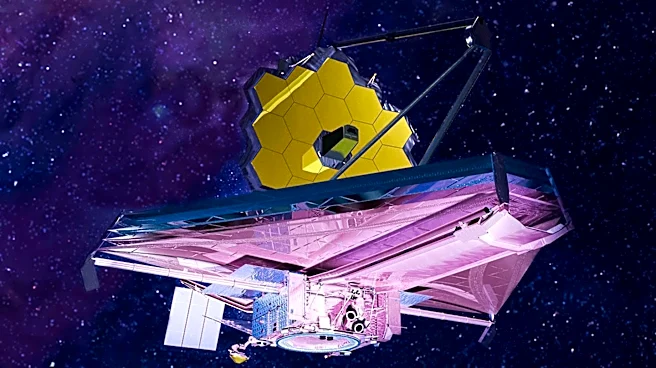
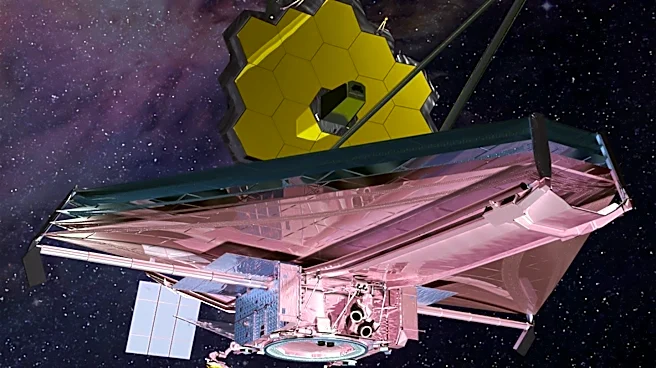
radio telescope in South Africa, with the white dwarf's characteristics revealed through archival data from the Hubble Space Telescope collected between 2006 and 2016. The white dwarf is the youngest ever observed in partnership with a millisecond pulsar and exhibits an unusual attenuation of ultraviolet radiation. This suggests that after it ceased transferring material to its neutron star companion approximately 600 million years ago, it was left enveloped in ejected stellar material, which is now blocking UV emissions.
Why It's Important?
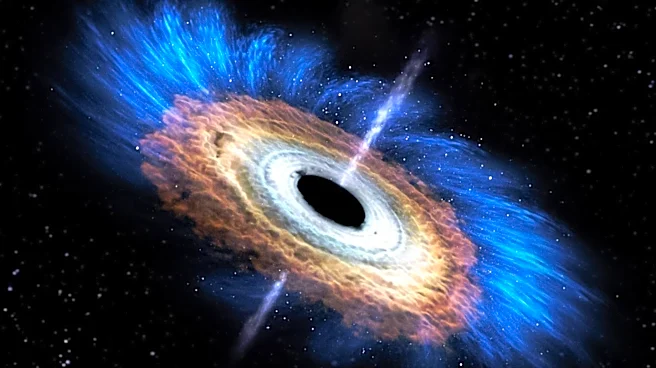
This discovery provides a unique opportunity to study the immediate aftermath of the 'pulsar recycling' process, where a neutron star accretes material from a companion, accelerating its spin. Understanding this early evolutionary stage of binary systems is crucial for refining models of stellar evolution and the life cycles of dead stars. The observed UV attenuation and the potential presence of surrounding material offer new insights into the physical processes that occur as a star transitions into a white dwarf in such extreme environments. This research could significantly impact our understanding of other similar systems and contribute to the ongoing effort to use millisecond pulsars as 'cosmic clocks' in pulsar timing arrays, which are vital for testing general relativity and studying gravity under extreme conditions.
What's Next?
Researchers will likely continue to observe NGC 362D to gather more data on the white dwarf's properties and the surrounding material. Future studies may involve using different wavelengths to probe the composition and distribution of the ejected envelope, potentially revealing more about the system's evolutionary history. The findings from NGC 362D could guide the search for other young white dwarf-pulsar binaries, helping astronomers build a more comprehensive picture of these rare systems. Further analysis of the system's behavior could also lead to improvements in the precision of pulsar timing arrays, enhancing our ability to detect gravitational waves and conduct more accurate tests of fundamental physics.
Beyond the Headlines
The study of systems like NGC 362D pushes the boundaries of our understanding of the universe's most extreme objects. The intricate dance between a dead star and a 'cosmic lighthouse' offers a natural laboratory for exploring fundamental physics, including the behavior of matter under immense gravitational forces and the mechanisms of stellar death and rebirth. This research not only deepens our knowledge of astrophysics but also underscores the interconnectedness of cosmic phenomena. The insights gained from these observations could have far-reaching implications for theoretical physics, potentially leading to new theories about gravity, spacetime, and the ultimate fate of stars, inspiring future generations of scientists and space enthusiasts.