
What's Happening?
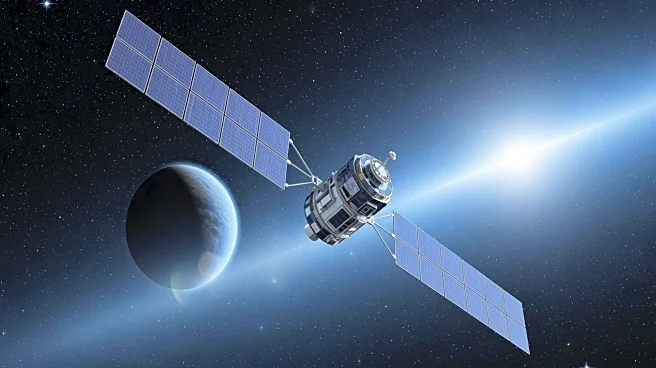
NASA has successfully launched the Pandora mission, a small observatory designed to study the atmospheres of exoplanets. The mission was launched aboard a SpaceX Falcon 9 rocket from Vandenberg Space Force
Base in California on January 11, 2026. Pandora is part of NASA's Astrophysics Pioneers program and aims to observe 20 exoplanets by measuring 10 transits of each. The mission will focus on stars less massive than the Sun, ranging from late-stage-M dwarfs to mid-K main-sequence stars. Pandora's objective is to separate the signals produced by stellar surface features from those made by chemical compounds in exoplanet atmospheres, such as water and hydrogen. The mission is expected to provide valuable data that complements observations made by the James Webb Space Telescope.
Why It's Important?
The Pandora mission represents a significant advancement in the study of exoplanetary atmospheres. By focusing on smaller, less costly missions, NASA aims to achieve substantial scientific returns without the need for large-scale flagship missions. The ability to distinguish between stellar activity and atmospheric signals is crucial for accurately characterizing exoplanet atmospheres, which could lead to the discovery of water-dominated worlds. Such findings would have profound implications for our understanding of planetary formation and the potential for life beyond Earth. Additionally, Pandora's data will be freely available on the NASA Exoplanet Archive, promoting further research and collaboration within the scientific community.
What's Next?
Following its launch, Pandora will enter a Sun-synchronous orbit, allowing for continuous observations of its target stars. The mission's commissioning phase will last one month, with data expected to be available five months after acquisition. Pandora's findings could guide future observations by larger telescopes, such as the James Webb Space Telescope and the upcoming Nancy Grace Roman Space Telescope. By providing complementary data, Pandora may help refine our understanding of exoplanetary atmospheres and identify promising targets for further study.
Beyond the Headlines
Pandora's mission underscores the growing trend of utilizing small satellites for specialized scientific inquiries. This approach allows for more frequent and targeted missions, potentially democratizing space research by lowering costs and increasing accessibility. The success of Pandora could pave the way for similar missions, expanding our ability to explore and understand the universe. Furthermore, the mission highlights the importance of international collaboration, as it is part of a rideshare payload that includes satellites from seven different nations.