


What's Happening?
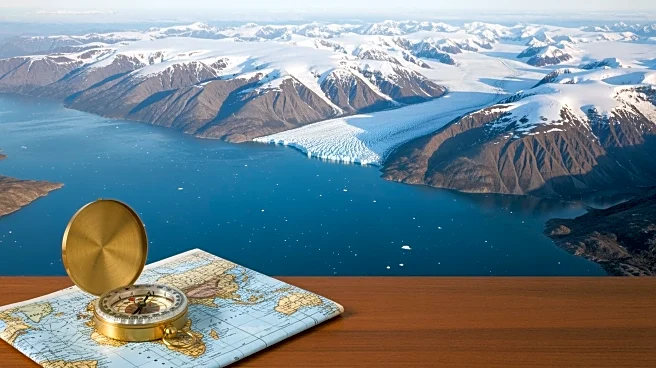
Greenland, an autonomous territory of Denmark, has become a focal point in geopolitical discussions due to its strategic location and abundant natural resources. President Trump has expressed interest in bringing Greenland under U.S. control, citing its importance
to defense strategy and resource acquisition. Historically, the U.S. has maintained a military presence in Greenland, notably through the Pituffik Space Base, established under the Defense of Greenland Treaty with Denmark in 1951. The island's vast size and sparse population, coupled with its significant mineral resources, make it a coveted asset. Greenland holds at least 25 of the 34 raw materials deemed critical by the European Union, including rare earth elements essential for various technologies. The melting Arctic ice is opening new trade routes, increasing the island's strategic value.
Why It's Important?
Greenland's strategic location in the Arctic Circle makes it a key player in global defense and trade strategies. The U.S. interest in Greenland is driven by the need to secure a reliable supply of rare earth elements, which are crucial for technological and military applications. As climate change continues to melt Arctic ice, new shipping routes are emerging, potentially altering global trade dynamics. This development could lead to increased competition among major powers, including the U.S., Russia, and China, for access to Greenland's resources. The geopolitical significance of Greenland is further underscored by its potential to reduce Western reliance on China for critical minerals, thereby enhancing national security and economic stability.
What's Next?
The future of Greenland's geopolitical status remains uncertain as international interest in the region grows. The U.S. may continue to pursue diplomatic and strategic avenues to strengthen its presence in Greenland, potentially through negotiations with Denmark and Greenland's local government. Meanwhile, other global powers, such as Russia and China, are likely to increase their activities in the Arctic, seeking to capitalize on the region's resources and strategic advantages. The evolving climate conditions will continue to play a significant role in shaping the geopolitical landscape, as nations vie for control over new trade routes and resource-rich territories.
Beyond the Headlines
The interest in Greenland raises ethical and environmental concerns, particularly regarding the impact of resource extraction on the local ecosystem and indigenous communities. The potential for increased military presence and industrial activity in the region could disrupt traditional ways of life and lead to environmental degradation. Additionally, the geopolitical competition for Greenland's resources highlights the broader issue of climate change and its role in reshaping global power dynamics. As nations grapple with these challenges, the need for sustainable and equitable solutions becomes increasingly urgent.