








What's Happening?
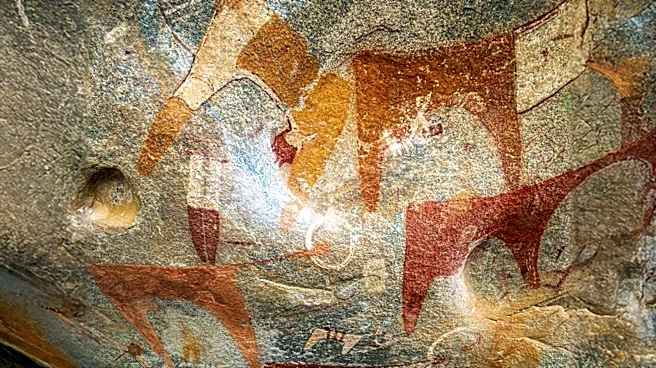
An international team of scientists has successfully recovered ancient human DNA from cave walls, marking a significant breakthrough in the study of prehistoric art. This discovery, published in Nature Communications, reveals that cave walls can preserve
genetic traces of individuals who interacted with them thousands of years ago. The research involved sampling 24 rock art panels across 11 caves in Spain and Portugal, including the Escoural Cave in Portugal. The DNA was found in a red ocher dot covered by calcite, which acted as a protective seal. This finding suggests that cave walls can serve as a new type of archive, potentially recording not only the art itself but also the movements and interactions of ancient peoples.
Why It's Important?
This discovery could revolutionize the understanding of prehistoric human activity and art. By providing a new method to trace human presence and interaction with cave environments, it opens up possibilities for more detailed reconstructions of ancient human behavior and social structures. The ability to extract DNA from cave walls could help identify the creators of prehistoric art and offer insights into the demographics of ancient populations. This method could also aid in distinguishing between art created by different human species, such as Homo sapiens and Neanderthals, thereby enriching the narrative of human evolution and migration.
What's Next?
Future research will likely focus on refining the techniques for extracting and analyzing DNA from cave walls to ensure accuracy and minimize damage to the art. Scientists may also explore other caves with better-preserved conditions to expand the dataset. Combining DNA analysis with other dating methods could provide more precise timelines for when specific artworks were created. This approach could lead to a deeper understanding of the cultural and ritualistic significance of cave art, as well as the social dynamics of the communities that created them.