






What's Happening?
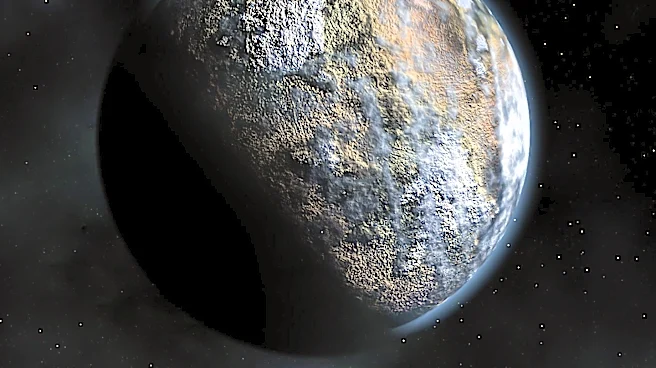
Researchers at the University of California, Irvine, have identified a nearby exoplanet, GJ 3378 b, as a promising candidate for hosting extraterrestrial life. This exoplanet, located just 25 light-years away from Earth, was first discovered in 2024.
The recent study, published in The Astrophysics Journal, suggests that GJ 3378 b may lie within the habitable zone, a region that receives the right amount of solar radiation to support liquid water. The exoplanet is a super-Earth, a rocky planet with a mass 2.3 times that of Earth, which is lower than previous estimates. This mass suggests it could have a similar atmospheric pressure to Earth, increasing the likelihood of it supporting life. However, there is currently no evidence of an atmosphere or liquid water on GJ 3378 b, and stellar winds may have eroded any atmosphere it once had.
Why It's Important?
The identification of GJ 3378 b as a potential host for life is significant as it brings scientists closer to finding extraterrestrial life. The proximity of this exoplanet to Earth makes it an ideal candidate for further study, potentially offering insights into the conditions necessary for life beyond our planet. The study's findings could influence future space exploration missions and the search for habitable planets. NASA's planned launch of the Habitable Worlds Observatory in the 2040s aims to image Earth-like planets around sun-like stars, which could further our understanding of planets like GJ 3378 b. The discovery underscores the importance of continued investment in space research and technology to explore the possibilities of life beyond Earth.
What's Next?
Future research will focus on confirming the presence of an atmosphere and liquid water on GJ 3378 b. Scientists aim to conduct more detailed studies to understand the exoplanet's potential to support life. NASA's upcoming missions, including the Habitable Worlds Observatory, will play a crucial role in these efforts. The observatory's goal is to image Earth-like planets, which could provide more data on GJ 3378 b and similar exoplanets. As technology advances, researchers hope to gather more information about the conditions on these distant worlds, potentially leading to groundbreaking discoveries in the search for extraterrestrial life.