
What's Happening?
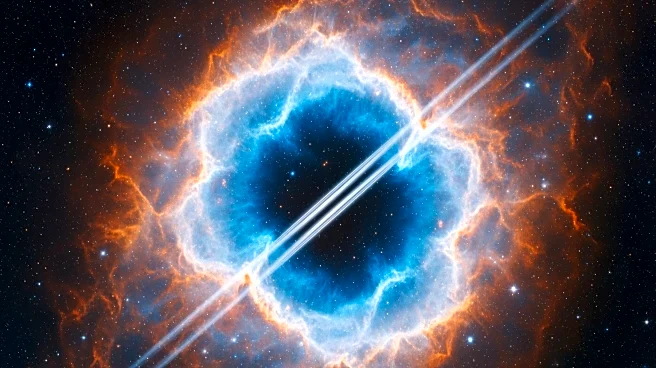
Astronomers have discovered a mysterious 'bar' of iron atoms within the Ring Nebula, also known as Messier 57, located approximately 2,000 light-years away. This discovery was made using the William Herschel
Telescope and a new instrument called WEAVE, which allowed for detailed observation of the nebula's chemical composition. The iron bar, which extends about 1,000 times the distance between Pluto and the sun, was found within the inner layer of the nebula. The mass of iron in this bar is comparable to that of Mars. The discovery raises questions about the formation of such structures, with possibilities including the ejection of outer layers by a dying star or the vaporization of an orbiting rocky planet. Further studies are planned to explore the presence of other chemical elements and to understand the formation mechanism of the iron bar.
Why It's Important?
The discovery of the iron bar in the Ring Nebula is significant as it challenges existing models of nebula formation and stellar evolution. Understanding the presence and formation of such structures could provide insights into the processes that occur when stars like our sun reach the end of their life cycle. This knowledge is crucial for predicting the future of our solar system, as the sun is expected to undergo a similar transformation in about 5 billion years. Additionally, the findings could lead to a reevaluation of the chemical compositions and structures of other planetary nebulas, potentially revealing new aspects of cosmic evolution.
What's Next?
The research team plans to conduct follow-up studies using WEAVE's LIFU mode at greater resolution to uncover more details about the iron bar's formation. These studies aim to determine whether other chemical elements coexist with the iron, which could help identify the correct model for the nebula's development. The team also hopes to discover similar structures in other nebulas, which would provide further evidence of the processes involved in their formation. Such discoveries could significantly enhance our understanding of stellar and nebular evolution.